Showing posts with label general conference. Show all posts

Monday, September 26, 2016

What Our Prophet Taught in April 2016

President Monson's remarks were brief, largely due to his failing health, however he did give some great council that we should take to heart. Below are a few of the things that he said:
  • "We are the recipients of a sacred trust [as Priesthood holders]. Much is expected of us."
  • We must guard/protect this Priesthood and be worthy of its blessings.
  • "Before you put yourself and your priesthood in jeopardy by venturing into places or participating in activities which are not worthy of you or of that priesthood, pause to consider the consequences."
  • "Remember who you are and what God expects you to become. You are a child of promise. You are a man of might. You are a son of God."
  • We must always be worthy to use the Priesthood for we never know when we will be called upon to use it!
  • "It has been said that the door of history turns on small hinges, and so do people’s lives. The choices we make determine our destiny."
  • "May we choose to build up within ourselves a great and powerful faith which will be our most effective defense against the designs of the adversary—a real faith, the kind of faith which will sustain us and will bolster our desire to choose the right. Without such faith, we go nowhere. With it, we can accomplish our goals."
  • Use the gift of repentance when you fall short.
  • "May we maintain the courage to defy the consensus. May we ever choose the harder right instead of the easier wrong."
  • Always choose Christ.

From the following talks in the April 2016 General Conference:

Sunday, November 8, 2015

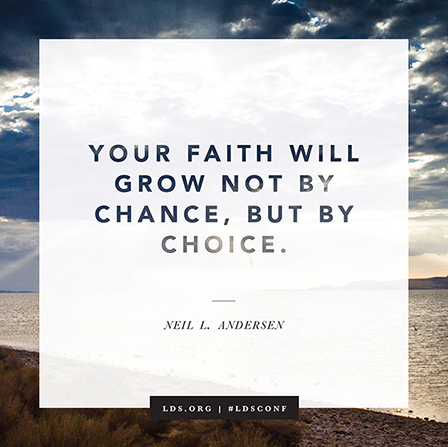
Faith, a Choice

Elder Andersen, of the Quorum of the Twelve Apostles, gave an excellent talk in October 2015 entitled Faith Is Not by Chance, but by Choice.

How Does the Savior See my Faith?
I hope we will all reflect upon and ponder the question Elder Andersen asked us to consider: "How does the Savior see my faith?" Pondering this question will help us see what we lack and inspire us to know what actions we can take in our lives to strengthen our faith.

Faith Misunderstood
It's true that faith is a gift from God; however, many misinterpret this to mean that you're either blessed with faith or you're not. It is a myth that some are born with faith or inherit faith. Those who seek faith will obtain it from the Lord. It is also commonly misunderstood that one faith promoting experience, such as a miraculous healing through a Priesthood blessing, or even a period of time where many faith promoting experiences occur, such as a two-year mission, are sufficient to sustain our faith throughout our lives. Faith has a short shelf life. As Elder Andersen says, "Your faith is either growing stronger or becoming weaker." Recall how Laman and Lemuel experienced many faith-promoting miracles (angels spoke to them!), yet their faith and repentance did not last long or sustain them through their trials.

Faith Is a Choice
Faith is a choice. Elder Andersen says, "The future of your faith is not by chance, but by choice." He continues, "How we live our lives increases or diminishes our faith. Prayer, obedience, honesty, purity of thought and deed, and unselfishness increase faith. Without these, faith diminishes."

Why Choose Faith
This may seem obvious to many, but I will share a few reasons why we should choose faith:

  • Faith in Jesus Christ is required to partake of his Atonement and be saved.
  • At baptism, we have covenanted (a sacred promise) with God that we would have faith. Additional covenants are made in the temple.
  • Faith gives us the power to overcome our trials and continue improving ourselves.
  • Both hope and charity require faith.
  • Living by faith provides a confidence, peace, and joy not found through any other means.
  • Faith can eliminate doubt, fear, and worry from our lives.

How Do I Choose Faith?
As Elder Andersen mentioned, there are many things we can do daily to choose faith. Many overlook these because of their simplicity. Naaman refused to bathe in the Jordan because it seemed to simple to cure him of his leprosy (later chose faith, obeyed, and was healed). How many Jews died from the poisonous serpents in the wilderness because they would not hearken unto Moses and look upon the brazen serpent to be healed? It was just too simple. Will we set aside personal prayer because of its simplicity? Will we forgo scripture study because it seems so simple, plus we've read them before? Will we cease to attend church meetings? Will we fail in our callings and duties or refuse to accept them? Choosing faith means choosing to keep the commandments of the Lord, to obey His chosen leaders, to live lives of integrity and virtue, and to serve those around us. As you can see, it's much more than checking a few boxes; it's choosing a faith-filled lifestyle.

Faith and Questions
Elder Andersen teaches, "Addressing honest questions is an important part of building faith, and we use both our intellect and our feelings." We are encouraged to be inquisitive, ever-learning, and always seeking further truth and light and knowledge. I hope nobody ever feels that they should not ask questions or that honest questions indicate a lack of faith. Joseph Smith would not have had his miraculous experience without humbly posing his honest question to God. Much of the revelation that we can and have (collectively) received has been the direct result of honest questions. In my personal life, I've asked questions of the Lord and of my leaders and benefited greatly by the answers I've received through the Spirit. Even as faith increases through honest questions and the revelation that results, we must not lose faith when answers come slowly or not at all.

Elder Andersen states, "Faith never demands an answer to every question but seeks the assurance and courage to move forward, sometimes acknowledging, 'I don't know everything, but I do know enough to continue on the path of discipleship.'"As we seek answers in faith, we will have the confidence to move forward.

Satan Seeks to Destroy Faith
It goes without saying that the adversary would like to destroy our faith. All around us the world, under his influence, seeks to undermine the faith that we have gained and to prevent us from choosing to strengthen our faith through righteous living. The Internet, and especially Social Media, is full of unbelievers who would sabotage our faith with the philosophies of men, societal trends, difficult questions that tug at our heart strings, and historical facts and fiction that are difficult to distinguish. Never before in the history of the world has anti-Mormon doctrine, largely perpetuated by apostates, been so accessible. Not only is it accessible, but those of us on Social Media often find ourselves inundated with it. This presents us with an crossroad of choice between faith and doubt. Elder Andersen teaches, "Immersing oneself in persistent doubt, fueled by answers from the faithless and the unfaithful, weakens one's faith in Jesus Christ and the Restoration."

The Apostle Paul taught, "...but the natural man receiveth not the things of the Spirit of God: for they are foolishness unto him: neither can he know them, because they are spiritually discerned." (1 Cor 2:14). Truth and spiritual light are not received through the endless debates in Social Media incited by the faithless and the unfaithful. Be careful about the subtle influence that "friends" and "thought leaders" in Social Media can have on us and our faith.

New Mediums, Same Old Tactics
The medium may be new but the tactics are as old as time. Satan counterfeits truth by mixing with it spiritually deadly falsehoods. Common today in Social Media are the traps of political correctness and tolerance. Charity, or pure love, is distorted and polluted with ideas such tolerating sin out of love for the sinner or accepting sin in the name of love. Sin is still sin regardless of how it is framed, or whether it is tolerated/encouraged by society, and it is still necessary to separate the sinner from the sin. We can (and must) love those who choose to sin while never condoning or accepting their actions. Doubt and confusion in this regard leave us susceptible to the warning given by Alexander Pope:

“Vice is a monster of so frightful mien
As to be hated needs but to be seen;
Yet seen too oft, familiar with her face,
We first endure, then pity, then embrace.”
Our faith diminishes as we allow ourselves to be surrounded by the doubts perpetuated by the faithless and unfaithful.

What to Do When Faith Is Challenged?
All of us have moments when our faith may be challenged and when it can be difficult to push aside doubts. Luckily, there are proactive steps we can take to choose faith in these moments.

Prayer
Humbly asking our Heavenly Father in prayer should be our first step. God is a reliable go-to source for comfort, guidance, and spiritual peace, which we receive through the Holy Ghost. The scriptures are full of stories of deliverance, and your loving Father will deliver you from doubt and confusion if you ask. The Lord promised that we can conquer Satan and the servants of Satan if we will "pray always" (D&C 10:5), and the Lord keeps his promises.

Remembering
Another powerful tool is remembering times in our lives when we have felt the witness of the Spirit. Journaling spiritual experiences can provide us with easy access to the memories and feelings we've had. Remember how you gained your testimony and the experiences that have strengthened it. Alma pleaded with the people of Zarahemla to remember: "if ye have experienced a change of heart, and if ye have felt to sing the song of redeeming love, I would ask, can ye feel so now?" (Alma 5:26). When Oliver Cowdery struggled with his faith, the revelation given to him was to remember the peace that the Lord had previously spoken to his mind (D&C 6:22-24).

God's Word
Open the scriptures. In Lehi's vision of the tree of life, it was the people who clung to the iron rod, which symbolises the word of God, that were able to escape the blinding temptations of the world. Elder Andersen shares this invitation, "When was the last time that you read the Book of Mormon from cover to cover? Read it again. It will increase your faith." I would add to that the invitation to again put Moroni's promise (Moroni 10:3-4) to the test by asking God to confirm to your heart and mind the truthfulness of the Book of Mormon as you study it. What greater witness can you receive than from God? And what better way to strengthen your faith and dispel doubt than through receipt of this divine confirmation? It's not a one-time thing - you can receive this spiritual confirmation as many times as you read, ponder, and sincerely ask to know of its truthfulness.

Service
Service is a miracle because it has the power to heal us of so many ailments, including doubt. Through providing meaningful service to others, we step outside of ourselves and focus more on the needs of others than our own. Service fills us with God's love, charity, which promotes faith. Service can change our heart as we are filled with this love.

Conclusion
Elder Andersen teaches that "your faith did not begin at birth, and it will not end at death. Faith is a choice." And in the words of President Monson, "Fear not... the future is as bright as your faith." I pray that we will all choose faith and enjoy the peace and happiness that results therefrom.


Saturday, November 10, 2012

Ask the Missionaries! They Can Help You.

In Elder Nelson's talk, Ask the Missionaries! They Can Help You, he describes the many ways that missionaries can help. He says, "All missionaries, younger and older, serve with the sole hope of making life better for other people."

But what if a young man doesn't feel the desire to serve? Elder Nelson explains that "A desire to serve is a natural outcome of one’s conversion, worthiness, and preparation." So if we do not feel the desire, we need to work on one or many of those areas: Conversion, worthiness or preparation.

To those who are not members of the Church: "As you learn more about us, you will find that we share many of the same values. We encourage you to keep all that is good and true and then see if we can add more."

Missionaries serve throughout the world today on the same charge that Jesus gave his disciples two millennia ago: "“go … and teach all nations,baptizing them in the name of the Father, and of the Son, and of the Holy Ghost.”"

His talk goes through and lists many of the things for which people could and should stop the missionaries to ask them questions such as returning to church, life after death, family history, the purpose of life, etc...

This also means we need well prepared missionaries!!

Sunday, October 14, 2012

"Can Ye Feel So Now" by Elder Cook

Notes from Elder Cooks talk in the October 2012 General Conference (here).

Elder Cook states that "the rising generation are better prepared [for missionary service] than any previous generation." As evidence he states, "Your knowledge of the scriptures is particularly impressive."

On the other hand, he acknowledges the greatness of the challenges we face.

Elder Cooks states:


In one of the most profound verses in all of scripture, Alma proclaims, “If ye have experienced a change of heart, and if ye have felt to sing the song of redeeming love, I would ask, can ye feel so now?”
Local leaders across the world report that when viewed as a whole, Church members, especially our youth, have never been stronger. But they almost always raise two concerns: first, the challenge of increased unrighteousness in the world and, second, the apathy and lack of commitment of some members. They seek counsel about how to help members to follow the Savior and achieve a deep and lasting conversion.
There is no doubt that the world is getting worse each year; consequently, we must have a stronger commitment to God and his gospel than ever before. Faith must replace fear, and we must achieve a deep and lasting conversion. 


In this talk our culture is accurately described in several ways:

  • "not conducive to righteousness or spiritual commitment"
  • "increased unrighteousness in the world "
  • "Everyone knows the culture is poisonous, and nobody expects that to change."
  • "The spiritual immune system of an entire civilization has been wounded."
These worldly conditions contribute to members sometimes being unable to "feel so now." He describes some of these members:
  • "Many who are in a spiritual drought and lack commitment have not necessarily been involved in major sins or transgressions, but they have made unwise choices."
  • "Some are casual in their observance of sacred covenants."
  • "Others spend most of their time giving first-class devotion to lesser causes."
  • "Some allow intense cultural or political views to weaken their allegiance to the gospel of Jesus Christ."
  • "Some have immersed themselves in Internet materials that magnify, exaggerate, and, in some cases, invent shortcomings of early Church leaders. Then they draw incorrect conclusions that can affect testimony."
But it is not too late for any of them, because repentance can lead them back to the path. Some advice:
  • "Immersion in the scriptures is essential for spiritual nourishment."
  • "The word of God inspires commitment and acts as a healing balm for hurt feelings, anger, or disillusionment."
  • When our commitment is diminished for any reason, part of the solution is repentance. Commitment and repentance are closely intertwined.
Great quote:
The Prophet Joseph pointed out that before your baptism, you could be on neutral ground between good and evil. But “when you joined this Church you enlisted to serve God. When you did that you left the neutral ground, and you never can [go] back.” His counsel was that we must never forsake the Master.

Unfortunately when we are not living up to the commitments we made at baptism, it's most often the result of transgression, not just "laziness" or "busyness" the way we tell ourselves it is:

While anything that lessens commitment is of consequence, two relevant challenges are both prevalent and significant. The first is unkindness, violence, and domestic abuse. The second is sexual immorality and impure thoughts. These often precede and are at the root of the choice to be less committed.

The responsibility is on parents to teach their children by example and through words. Our children are exposed to the evils of immorality and pornography at a terribly young age, and we must prepare them to be strong enough to overcome.

Parents, the days are long past when regular, active participation in Church meetings and programs, though essential, can fulfill your sacred responsibility to teach your children to live moral, righteous lives and walk uprightly before the Lord. With President Monson’s announcement this morning, it is essential that this be faithfully accomplished in homes which are places of refuge where kindness, forgiveness, truth, and righteousness prevail. Parents must have the courage to filter or monitor Internet access, television, movies, and music. Parents must have the courage to say no, defend truth, and bear powerful testimony. Your children need to know that you have faith in the Savior, love your Heavenly Father, and sustain the leaders of the Church. Spiritual maturity must flourish in our homes.

When it comes to morality, some adults believe that adherence to a single, overriding humanitarian project or principle nullifies the need to comply with the Savior’s teachings. They say to themselves that sexual misconduct is “a small thing … [if I am] a kind and charitable person.”21Such thinking is a gross self-deception. Some young people inform me that in our current culture it is not “cool” to try too hard in many areas, including living strictly in accordance with righteous principles.22 Please do not fall into this trap.
At baptism we promise to take upon us “the name of [Jesus] Christ, having [the] determination to serve him to the end.”23 Such a covenant requires courageous effort, commitment, and integrity if we are to continue to sing the song of redeeming love and stay truly converted.
I know that's a long quote but it could not be paraphrased. Let me reiterate Elder Cook's words: "DO NOT FALL INTO THIS TRAP!" We can not rationalize away our sins. Let us have and show the courageous effort, commitment and integrity required to live the gospel and stay truly converted!

Sunday, May 27, 2012

President Monson - As We Gather Once Again

April 2012 General Conference Saturday Morning (link to the talks)


President Monson - As We Gather Once Again 
The purpose of General Conference is to "strengthen one another, to extend encouragement, to provide comfort, to build faith. We are here to learn." We can all "be enlightened and uplifted and comforted as the Spirit of the Lord is felt." General Conference brings the Spirit more fully into our lives and helps us make necessary changes by inspiring us with greater incentive and courage. It helps us live worthily and "oppose evil wherever it is found."  


Sunday, March 6, 2011

Why Are There So Many Rules?!

From Elder Arnold's talk "What Have You Done With My Name". This is one of his wife's stories:


“When I was 15 years old, I often felt that there were too many rules and commandments. I wasn’t sure that a normal, fun-loving teenager could enjoy life with so many restrictions. Furthermore, the many hours spent working on my father’s ranch were seriously dipping into my time with my friends.
“This particular summer, one of my jobs was to ensure that the cows grazing on the mountain pasture did not break through the fence and get into the wheat field. A cow grazing on the growing wheat can bloat, causing suffocation and death. One cow in particular was always trying to stick her head through the fence. One morning, as I was riding my horse along the fence line checking on the cattle, I found that the cow had broken through the fence and gotten into the wheat field. To my dismay, I realized that she had been eating wheat for quite some time because she was already bloated and looked much like a balloon. I thought, ‘You stupid cow! That fence was there to protect you, yet you broke through it and you have eaten so much wheat that your life is in danger.’
“I raced back to the farmhouse to get my dad. However, when we returned, I found her lying dead on the ground. I was saddened by the loss of that cow. We had provided her with a beautiful mountain pasture to graze in and a fence to keep her away from the dangerous wheat, yet she foolishly broke through the fence and caused her own death.
“As I thought about the role of the fence, I realized that it was a protection, just as the commandments and my parents’ rules were a protection. The commandments and rules were for my own good. I realized that obedience to the commandments could save me from physical and spiritual death. That enlightenment was a pivotal point in my life.”

I really like this story because of the message it teaches. It is so easy to see the happy hours, late nights out, and Sunday boating that our friends enjoy and thing to ourselves, "The grass looks so much greener outside the fence." Satan is skillful at making sin (both sins of commission and sins of omission) appear glamorous and fun. He does everything in his power to get us to forget that "wickedness never was happiness." If we see the rules, guidelines, prophetic counsel, laws, commandments, etc as a restrictive fence keeping us from the "pleasures" of the world, our perspective can and likely will lead to a fatal and foolish end as we "break through the fence" to our own demise. God knows that the other side of the fence contains nothing but misery and therefore has given us the fence to protect us from that misery. It is important to keep this in perspective so that we can be grateful for the fence and it's protective influence in our lives rather than resenting it and looking for any way to climb over or break through it.

God has given us Holy Scripture and inspired Prophets to protect us as we journey along the path that will keep us happy and lead to eternal joy. I know that obedience leads to happiness. Jesus taught that you too can know this for yourself: "If any man will do his will, he shall know of the doctrine... John 7:17".

Sunday, February 27, 2011

Rest Unto Your Souls by Per G Malm

The full text of the talk can be found here.
"To find rest unto our souls includes peace of mind and heart, which is the result of learning and following the doctrine of Christ, and becoming Christ’s extended hands in serving and helping others. Faith in Jesus Christ and following His teachings give us a firm hope, and this hope becomes a solid anchor to our souls. We can become steadfast and immovable. We can have lasting inner peace; we can enter into the rest of the Lord."
Don't we all want peace of mind and heart? I agree with Elder Malm that we must follow the doctrine of Christ and be instruments in His hands to serve those around us.
"Along our way we are aided in our choices through the sustaining influence of the Spirit. Now, if we choose to act contrary to the light and understanding that we have, we will experience a bad conscience, which of course does not feel good. But a bad conscience is a blessing in that we immediately are reminded that it is time to repent. When we are humble and desire to do what is right, we will be anxious to act promptly to change our ways, while those who are proud and who may seek “to become a law unto [themselves]” (D&C 88:35) will allow Satan to lead “them by the neck with a flaxen cord, until he bindeth them with his strong cords forever” (2 Nephi 26:22) unless the spirit of repentance enters their hearts. To follow evil influences can never result in a feeling of peace simply because peace is a gift from God and it only comes through the Spirit of God. “Wickedness never was happiness” (Alma 41:10)."
My previous post was about having the Gift of the Holy Ghost. This influence can guide us to make right choices; however, none of us our perfect and at times we slip up. As much as we hate a guilty conscience, it really is a blessing to us if it leads us to sincere repentance. But if we are proud, then Satan will lead us in a downward spiral that can be difficult to escape. Just as the prophet Alma taught in the Book of Mormon, truly "Wickedness never was happiness."
"When we learn to handle the small and simple daily things in a wise and inspired way, the result is a positive influence that will solidify harmony in our souls and build up and strengthen those around us. This is so because everything which invites us to do good “is sent forth by the power and gift of Christ; wherefore [we] may know with a perfect knowledge it is of God” (Moroni 7:16)."
Choose the right and you'll always have the peace you seek. Wear yourself out in the service of others and your soul will find the rest it seeks. It may sound counter-intuitive, but it's true! I learned that it's true on my mission.

Tuesday, June 29, 2010

Healing the Sick by Elder Dallin H. Oaks of the Quorum of the 12 Apostles

I really enjoyed this talk "Healing the Sick" by Elder Oaks in the April 2010 General Conference. I'll include some of my favorite quotes in this post, but check out the full text by clicking here.

He explains what we believe as Latter-day Saints:
Latter-day Saints believe in applying the best available scientific knowledge and techniques. We use nutrition, exercise, and other practices to preserve health, and we enlist the help of healing practitioners, such as physicians and surgeons, to restore health.
The use of medical science is not at odds with our prayers of faith and our reliance on priesthood blessings. When a person requested a priesthood blessing, Brigham Young would ask, “Have you used any remedies?” To those who said no because “we wish the Elders to lay hands upon us, and we have faith that we shall be healed,” President Young replied: “That is very inconsistent according to my faith. If we are sick, and ask the Lord to heal us, and to do all for us that is necessary to be done, according to my understanding of the Gospel of salvation, I might as well ask the Lord to cause my wheat and corn to grow, without my plowing the ground and casting in the seed. It appears consistent to me to apply every remedy that comes within the range of my knowledge, and [then] to ask my Father in Heaven . . . to sanctify that application to the healing of my body.”
Miracle of Healing is scriptural and modern as well:
Many scriptures teach that the servants of the Lord “shall lay hands on the sick, and they shall recover” (Mark 16:18). Miracles happen when the authority of the priesthood is used to bless the sick. I have experienced these miracles. As a boy and as a man I have seen healings as miraculous as any recorded in the scriptures, and so have many of you.
He lists 5 parts of a priesthood blessing: (1) Anointing, (2) the sealing of the anointing, (3) faith, (4) the words of the blessing, and (5) the will of the Lord.

Anointing:


In the New Testament we read that Jesus’s Apostles “anointed with oil many that were sick, and healed them” (Mark 6:13). The book of James teaches the role of anointing in connection with the other elements in a healing blessing by priesthood authority:
“Is any sick among you? let him call for the elders of the church; and let them pray over him, anointing him with oil in the name of the Lord:
“And the prayer of faith shall save the sick, and the Lord shall raise him up” (James 5:14–15).

 Sealing the Anointing:


When elders anoint a sick person and seal the anointing, they open the windows of heaven for the Lord to pour forth the blessing He wills for the person afflicted.
President Brigham Young taught: “When I lay hands on the sick, I expect the healing power and influence of God to pass through me to the patient, and the disease to give way. . . . When we are prepared, when we are holy vessels before the Lord, a stream of power from the Almighty can pass through the tabernacle of the administrator to the system of the patient, and the sick are made whole.”
Faith:


President Spencer W. Kimball said: “The need of faith is often underestimated. The ill one and the family often seem to depend wholly on the power of the priesthood and the gift of healing that they hope the administering brethren may have, whereas the greater responsibility is with him who is blessed. . . . The major element is the faith of the individual when that person is conscious and accountable. ‘Thy faith hath made thee whole’ [Matthew 9:22] was repeated so often by the Master that it almost became a chorus.”
Words of Blessing:


These words can be very important, but their content is not essential and they are not recorded on the records of the Church. In some priesthood blessings—like a patriarchal blessing—the words spoken are the essence of the blessing. But in a healing blessing it is the other parts of the blessing—the anointing, the sealing, faith, and the will of the Lord—that are the essential elements. . .


(I thought this was comforting):

Fortunately, the words spoken in a healing blessing are not essential to its healing effect. If faith is sufficient and if the Lord wills it, the afflicted person will be healed or blessed whether the officiator speaks those words or not. Conversely, if the officiator yields to personal desire or inexperience and gives commands or words of blessing in excess of what the Lord chooses to bestow according to the faith of the individual, those words will not be fulfilled. Consequently, brethren, no elder should ever hesitate to participate in a healing blessing because of fear that he will not know what to say. The words spoken in a healing blessing can edify and energize the faith of those who hear them, but the effect of the blessing is dependent upon faith and the Lord’s will, not upon the words spoken by the elder who officiated.


Will of the Lord:
We must always remember that faith and the healing power of the priesthood cannot produce a result contrary to the will of Him whose priesthood it is...


We do all that we can for the healing of a loved one, and then we trust in the Lord for the outcome.

Sunday, June 27, 2010

Place No More for the Enemy of My Soul by Elder Jeffrey R. Holland of the Quorum of the 12 Apostles

This post includes some key quotes and highlights from the talk "Place No More for the Enemy of My Soul" given by Elder Jeffrey R. Holland, one of the 12 Apostles, in the April 2010 General Conference. For the full text of his talk please click here.

Elder Holland describes the "moral decay" all around us:
"Most days we all find ourselves assaulted by immoral messages of some kind flooding in on us from every angle. The darker sides of the movie, television, and music industry step further and further into offensive language and sexual misconduct."
He warns that "immoral activity is not just a man's problem, and husbands aren't the only ones offending." He then talks about why lust is considered one of the deadliest of sins:
"Well, in addition to the completely Spirit-destroying impact it has upon our souls, I think it is a sin because it defiles the highest and holiest relationship God gives us in mortality—the love that a man and a woman have for each other and the desire that couple has to bring children into a family intended to be forever.
But lust is characterized by shame and stealth and is almost pathologically clandestine—the later and darker the hour the better, with a double-bolted door just in case. Love makes us instinctively reach out to God and other people. Lust, on the other hand, is anything but godly and celebrates self-indulgence. Love comes with open hands and open heart; lust comes with only an open appetite." 
Elder Holland then gives some tips to help:

  • "Start by separating yourself from people, materials, and circumstances that will harm you. As those battling something like alcoholism know, the pull of proximity can be fatal."
  • Seek help! "Pray without ceasing. Ask for angels to help you."
  • "The only real control in life is self-control...If a TV show is indecent, turn it off. If a movie is crude, walk out. If an improper relationship is developing, sever it."
  • "An old proverb says that a journey of a thousand miles begins with one step,5 so watch your step."
I especially liked this warning and counsel:
"Like thieves in the night, unwelcome thoughts can and do seek entrance to our minds. But we don’t have to throw open the door, serve them tea and crumpets, and then tell them where the silverware is kept! (You shouldn’t be serving tea anyway.) Throw the rascals out! Replace lewd thoughts with hopeful images and joyful memories; picture the faces of those who love you and would be shattered if you let them down. More than one man has been saved from sin or stupidity by remembering the face of his mother, his wife, or his child waiting somewhere for him at home. Whatever thoughts you have, make sure they are welcome in your heart by invitation only."

Elder Holland also counsels us to "cultivate and be where the Spirit of the Lord is," including our own homes, and to "go to the temple as often as [our] circumstances allow." Speaking of our covenant that we renew each Sunday:
"We pledge every Sunday of our lives to take upon ourselves His name and promise to 'always remember him.' So let us work a little harder at remembering Him—especially that He has 'borne our griefs, and carried our sorrows . . . , [that] he was bruised for our iniquities . . . ; and with his stripes we are healed.'"
His concluding advice and promise:
"When we face such temptations in our time, we must declare, as young Nephi did in his, “[I will] give place no more for the enemy of my soul.” We can reject the evil one. If we want it dearly and deeply enough, that enemy can and will be rebuked by the redeeming power of the Lord Jesus Christ. Furthermore, I promise you that the light of His everlasting gospel can and will again shine brightly where you feared life had gone hopelessly, helplessly dark."

Sunday, June 13, 2010

Watching With All Perseverance by Elder David A Bednar, Quorum of the Twelve Apostles

This was one of the best talks for parents that I have ever heard! I'd like to highlight some of the key points that Elder Bednar made that I really liked. To read the complete talk (and I highly recommend you do), please go to this link.

He gives this talk in hopes of helping parents develop "a spiritual early warning system that can help [them] to be watchful and discerning concerning their children." The system is composed of three basic components: (1) Read and talk to your kids about the Book of Mormon, (2) Bear testimony of gospel truths spontaneously with your children, and (3) Invite children as gospel learners to act and not merely be acted upon. These things will help parents recognize early signals of spiritual growth as well as challenges and help parents to be "better prepared to receive inspiration to strengthen and help" their children.

#1- Reading and Talking about the Book of Mormon
About the power of the Book of Mormon:
"The convincing and converting powers of the Book of Mormon come from both a central focus upon the Lord Jesus Christ and the inspired plainness and clarity of its teachings." 
He says that because the Book of Mormon (1) focuses on the Savior and (2) teaches very plainly, it "speaks to the spirit and to the heart of the reader like no other volume of scripture." More benefits of reading the Book of Mormon with our kids:
"Regular reading of and talking about the Book of Mormon invite the power to resist temptation and to produce feelings of love within our families. And discussions about the doctrines and principles in the Book of Mormon provide opportunities for parents to observe their children, to listen to them, to learn from them, and to teach them."
Some of these quotes are just too good to paraphrase, this is how he ends this section:
"Youth of all ages, even infants, can and do respond to the distinctive spirit of the Book of Mormon. Children may not understand all of the words and stories, but they certainly can feel the “familiar spirit” described by Isaiah (Isaiah 29:4; see also 2 Nephi 26:16). And the questions a child asks, the observations a child shares, and the discussions that occur provide crucial spiritual early warning signals. Importantly, such conversations can help parents to discern what their children are learning, thinking, and feeling about the truths contained in this sacred volume of scripture, as well as the difficulties they may be facing."
#2- Bearing Testimony Spontaneously
Elder Bednar explains that "testimony is personal knowledge, based upon the witness of the Holy Ghost, that certain facts of eternal significance are true." What a great definition! As he explains how we should bear testimony to our children, he says that "such occasions need not be programmed, scheduled, or scripted." In fact, it's best when it is spontaneous. He also teaches that a testimony "need not always begin with the phrase 'I bear you my testimony.'" He explains that you should note the reactions of your children as you bear testimony to them- here's why:
"The reactions of children to such impromptu testimony bearing and their eagerness or reluctance to participate are potent sources of spiritual early warning signals. A child’s expression about a lesson learned in family scripture study or a candid statement of concern about a gospel principle or practice can be most illuminating and help parents better understand a child’s specific question or needs. Such discussions—especially when parents are as eager to listen intently as they are to talk—can foster a supportive and secure environment in the home and encourage ongoing communication about difficult topics."
#3- Inviting Children to Act
This is a great illustration of his point:
"Giving a man a fish feeds him for one meal. Teaching a man to fish feeds him for a lifetime. As parents and gospel instructors, you and I are not in the business of distributing fish; rather, our work is to help our children learn “to fish” and to become spiritually steadfast. This vital objective is best accomplished as we encourage our children to act in accordance with correct principles—as we help them to learn by doing. “If any man will do his will, he shall know of the doctrine, whether it be of God” (John 7:17). Such learning requires spiritual, mental, and physical exertion and not just passive reception."
If you have children, here are some questions to ponder: 
"Are you and I helping our children become agents who act and seek learning by study and by faith, or have we trained our children to wait to be taught and acted upon? Are we as parents primarily giving our children the equivalent of spiritual fish to eat, or are we consistently helping them to act, to learn for themselves, and to stand steadfast and immovable? Are we helping our children become anxiously engaged in asking, seeking, and knocking?"
One of the reasons it is so important that our children learn to act on their own is that "the tuition of diligence and of learning by study and also by faith must be paid to obtain and personally 'own' such a knowledge." Our children need to learn to act for themselves in spiritual ways - not just physically - so that they are "prepared spiritually for the challenges of mortality."


In conclusion, I'd like to share Elder Bednar's testimony of these principles:
"The spiritual discernment and inspiration you will receive from the combination of these three holy habits will enable you to stand as watchmen on the tower for your families"

Sunday, June 6, 2010

When the Lord Commands

I would like to share a few quotes from the talk that Elder Bruce A. Carlson of the Quorum of the 70 gave in the April 2010 General Conference entitled "When the Lord Commands". The full text of the talk can be found here.

Elder Carlson quotes the Harold B. Lee, a prophet a few decades back, who said:
"The safety of the church lies in the members keeping the commandments. . . .As they keep the commandments, blessings will come."
Elder Carlson gives three reasons why we sometimes fall short of obeying the commandments of God. The first reason is that we rationalize that the commandment doesn't apply to me. He shares the story of Jeroboam from the Old Testament to illustrate this trap. Jeroboam justified the introduction of satanic worship rituals in order to satisfy the people, believing that the Lord's commandments did not apply to him (1 Kings 12). All of his descendants were killed as a result of his disobedience.

Another reason is that we may feel the commandment is not important. He illustrates this with the story of Naaman from the Old Testament. Naaman was told to wash seven times in the muddy Jordan River in order to be cleansed of his leprosy. He was angry and about to disobey the counsel of the prophet because it seemed such a trite, unimportant act. Lucky for him, he was convinced by his servant to obey and as a result he was cured of his leprosy (2 Kings 5). Elder Carlson promises:
"Obedience to the Lord’s commands, in spite of how trivial or unimportant we believe them to be, will surely bring His promised blessings."
The third reason that he gives is that we sometimes think that a commandment is just too hard. He uses the story of Lehi's eldest sons complaining that the commandment of the Lord to retrieve the brass plates was too hard to accomplish. Of course we know that Nephi, the youngest son, trusted in the Lord and was led by the Spirit to fulfill the commandment and obtain the plates (1 Ne 3-4). Elder Carlson comments:
"At times we may rationalize that the Lord will understand our disobedience because our special circumstances make adherence to His laws difficult, embarrassing, or even painful. However, faithful obedience, regardless of the apparent size of the task, will bring the Lord’s guidance, assistance, and peace."
Let's not forget the Lord's promise to us as we are obedient:
"If you keep my commandments and endure to the end you shall have eternal life."(Doctrine and Covenants 14:7)
Obedience is much more important for us personally, than it is for our Father in Heaven. It benefits us beyond what we can imagine. Elder Carlson ends his talk with this testimony:
"Obedience to the Lord’s commandments provides us confidence in our chosen path, qualifies us for His guidance and direction as we pursue our efforts, and offers us the potential to become like our Savior, Jesus Christ, and return to our Father’s presence."

Helping Hands, Saving Hands

Elder Koichi Aoyagi of the Quorum of the 70 gave a great talk in this April's General Conference entitled "Helping Hands, Saving Hands." For the full text of the talk, click here.

I just wanted to share the concluding paragraphs, which contain a quote from President Thomas S. Monson and Elder Aoyagi's testimony:
I close with a quote by President Thomas S. Monson: “My brothers and sisters, we are surrounded by those in need of our attention, our encouragement, our support, our comfort, our kindness—be they family members, friends, acquaintances, or strangers. We are the Lord’s hands here upon the earth, with the mandate to serve and to lift His children. He is dependent upon each of us.”
May we follow the counsel and example of the prophet and each day seek out those in need, that we might be the hands of the Lord in helping and saving His children, I pray in the name of Jesus Christ, amen.
I just love that- "we are the Lord's hands." So let's look for ways to help those around us!

Thursday, May 27, 2010

The Blessing of Scripture by Elder D. Todd Christofferson

Quotes and remarks are based on the talk entitled "The Blessing of Scripture" by Elder D. Todd Christofferson of the Quorum of the 12 Apostles in the April 2010 General Conference- the complete talk can be found here.

Elder Christofferson begins his message by relating the story of William Tyndale, how he translated the Bible into English, and finally was martyred for it. He also speaks of many others who suffered and risked much to preserve the word of God throughout the centuries. He poses these thought-provoking questions:
"What did they know about the importance of scriptures that we also need to know? What did people in 16th-century England, who paid enormous sums and ran grave personal risks for access to a Bible, understand that we should also understand?"
I wonder how much we really take the Bible and other scriptures for granted when people literally gave their lives in order to have this sacred text and to make it available for us...


The talk's thesis:
"Through the scriptures, God does indeed “show forth his power” to save and exalt His children. By His word, as Alma said, He enlarges our memory, sheds light on falsehood and error, and brings us to repentance and to rejoice in Jesus Christ, our Redeemer."
He then continues to expound some of the ways the scriptures can and should bless our lives:
"The scriptures enlarge our memory by helping us always to remember the Lord and our relationship to Him and the Father. They remind us of what we knew in our premortal life."
"...And as these things penetrate our minds and hearts, our faith in God and His Beloved Son takes root."
"God uses scripture to unmask erroneous thinking, false traditions, and sin with its devastating effects. He is a tender parent who would spare us needless suffering and grief and at the same time help us realize our divine potential. " 
Another good quote to get you thinking:
"In Tyndale’s day, scriptural ignorance abounded because people lacked access to the Bible, especially in a language they could understand. Today the Bible and other scripture are readily at hand, yet there is a growing scriptural illiteracy because people will not open the books. Consequently they have forgotten things their grandparents knew."

"His commandments are the voice of reality and our protection against self-inflicted pain. The scriptures are the touchstone for measuring correctness and truth, and they are clear that real happiness lies not in denying the justice of God or trying to circumvent the consequences of sin but in repentance and forgiveness through the atoning grace of the Son of God (see Alma 42)."
This is why the scriptures are so essential to society:
"Where scriptural truths are ignored or abandoned, the essential moral core of society disintegrates and decay is close behind. In time, nothing is left to sustain the institutions that sustain society."
And why they are so incredibly important for us:
"In the end, the central purpose of all scripture is to fill our souls with faith in God the Father and in His Son, Jesus Christ"

"Faith comes by the witness of the Holy Spirit to our souls, Spirit to spirit, as we hear or read the word of God. And faith matures as we continue to feast upon the word."
The role of the Holy Ghost and revelation:
"Therefore, being in the scriptures is one way we receive the Holy Ghost. Of course, scripture is given through the Holy Ghost in the first place (see 2 Peter 1:21; D&C 20:26–27; 68:4), and that same Spirit can attest its truth to you and me. Study the scriptures carefully, deliberately. Ponder and pray over them. Scriptures are revelation, and they will bring added revelation."
Let us not take the scriptures for granted. Let us remember their value in our lives and the benefit that can be ours as we study them. We are so blessed to have the scriptures in so many forms including free online: scriptures.lds.org. "Surely with this blessing the Lord is telling us that our need for constant recourse to the scriptures is greater than in any previous time."


Sunday, May 23, 2010

Mothers Teaching Children in the Home by Elder L. Tom Perry

Quotes and remarks are based on the talk entitled "Mothers Teaching children in the Home" by Elder L. Tom Perry of the Quorum of the 12 Apostles in the April 2010 General Conference- the complete talk can be found here.

I completely agree with what Elder Perry teaches about how mothers have a great responsibility to teach their children true principles while they are young. I'd like to just share some quotes that I liked from the talk below:

In speaking of his mother and her preparation of Relief Society lessons:
"...she prepared so thoroughly, first, to be an example to her children of diligent Church service and, second, because she recognized that what she learned from preparing her lessons could be used repeatedly for a higher purpose—teaching her sons and her daughters."
"...parents are entrusted with the education of their children and, ultimately, parents must ensure that their children are being taught what their Heavenly Father would have them learn."
"Many activities link the values of one generation to the next, but perhaps the most central of these activities is parents teaching children in the home. This is especially true when we consider the teaching of values, moral and ethical standards, and faith."
"Parents must resolve that teaching in the home is a most sacred and important responsibility. While other institutions, such as church and school, can assist parents to “train up a child in the way he [or she] should go” (Proverbs 22:6), ultimately this responsibility rests with parents. According to the great plan of happiness, it is parents who are entrusted with the care and development of our Heavenly Father’s children."
"Parents must bring light and truth into their homes by one family prayer, one scripture study session, one family home evening, one book read aloud, one song, and one family meal at a time. They know that the influence of righteous, conscientious, persistent, daily parenting is among the most powerful and sustaining forces for good in the world. The health of any society, the happiness of its people, their prosperity, and their peace all find common roots in the teaching of children in the home."
"...you must begin by teaching at the cradle-side. You are to teach by example as well as precept" [quoting Joseph Fielding Smith]
"Our teaching in the home prepares us to teach more effectively at church, and our teaching at church helps us to teach more effectively at home."
"The onslaught of wickedness against our children is at once more subtle and more brazen than it has ever been. Teaching the gospel of Jesus Christ in the home adds another layer of insulation to protect our children from worldly influences."
He concludes with this:
"God bless you wonderful mothers and fathers in Zion. He has entrusted to your care His eternal children. As parents we partner, even join, with God in bringing to pass His work and glory among His children. It is our sacred duty to do our very best."
Just remember, if you're not teaching your children how to walk in light and truth, then they are learning how to walk from friends, classmates, and the media...kind of a scary thought!

Sunday, May 16, 2010

Help Them on Their Way By President Henry B. Eyring

Quotes and remarks are based on the talk entitled Help Them on Their Way by President Henry B. Eyring of the First Presidency of the Church in the April 2010 General Conference. The talk can be found here.

President Eyring explains that it is much better to teach children while they're young to have faith and obey the commandments:
"So we help God’s children best by providing ways to build faith in Jesus Christ and His restored gospel when they are young. And then we must help rekindle that faith quickly before it dims as they wander off the path."
He illustrates with a story of a woman that came to see him who had deviated from the path of righteousness, had made many mistakes, and wanted desperately to change her life from misery to happiness. She had grown up in the Church before making incorrect choices that led her to stray from it. How much easier it would have been for her to have had support and encouragement as a child than to have to go through the bitter process of repentance and lifestyle change.

He explains that we have a "nearly continuous opportunity to help travelers among God’s children" as we are all constantly trying to stay on the path. Satan fights hard to lead people astray, so we need to help one another out to overcome his evil influence! This is said to perfectly to paraphrase:
"Foreseeing the needs of His children, a loving Heavenly Father placed directions and rescuers along their way. He sent His Son, Jesus Christ, to make safe passage possible and visible. He called as His prophet in these times President Thomas S. Monson. Since his youth President Monson has taught not only how to stay on the path but also how to rescue those who have been led away into sorrow.

Heavenly Father has assigned us to a great variety of stations to strengthen and, when needed, to lead travelers to safety. Our most important and powerful assignments are in the family. They are important because the family has the opportunity at the start of a child’s life to put feet firmly on the path home. Parents, brothers and sisters, grandparents, aunts and uncles are made more powerful guides and rescuers by the bonds of love that are the very nature of a family."

President Eyring says that "if the children are strengthened with faith and testimony, they will be less likely to need rescue as teenagers. They realize that a strong spiritual foundation can make the difference for a lifetime." This is why it's so important to teach children while they're young and innocent.

If you think that you can't make a difference, you're absolutely mistaken. You can change a child's life. He says, "We all can help. Grandmothers, grandfathers, and every member who knows a child can help. It doesn’t take a formal calling in Primary. Nor is it limited by age. One such woman, as a younger person, was on the Primary general board that helped create the CTR motto." I like how President Eyring describes the help available for teenagers during those difficult teen years:

"The Lord has placed a pattern of rescue and rescuers in His kingdom. In His wisdom the Lord has inspired His servants to place some of the most powerful ways to strengthen us and to put in place the best rescuers as we pass through the teenage years.

You know of two powerful programs provided by the Lord. One, for young women, is called Personal Progress. The other, for Aaronic Priesthood holders, is called Duty to God. We encourage young people in the rising generation to see their own potential to build great spiritual strength. And we plead with those who care about those young people to rise to what the Lord requires of us to help them. And since the future of the Church depends upon them, all of us care."

He mentions how when he was growing up, such programs did not exist and he had few things in his life that challenged him as these programs are meant to challenge youth. He says:
"On reflection I realized that the contents of these booklets are a physical representation of the Lord’s trust in the rising generation and in all of us who love them. And I have seen evidence that the trust is well placed."
How can we help them? He says:
"Of all the help we can give these young people, the greatest will be to let them feel our confidence that they are on the path home to God and that they can make it. And we do that best by going with them. Because the path is steep and sometimes rocky, they will at times feel discouraged and even stumble...
The example they most need from us is to do what they must do. We need to pray for the gifts of the Spirit. We need to ponder in the scriptures and in the words of living prophets. We need to make plans which are not only wishes but covenants. And then we need to keep our promises to the Lord. And we need to lift others by sharing with them the blessings of the Atonement which have come in our lives. And we need to exemplify in our own lives the steady and prolonged faithfulness that the Lord expects of them."
This will not only help them to find joy in their lives, but bring us great joy as we serve them and watch them grow in the gospel of Jesus Christ. Lastly, in closing, I want to share the testimony that he ends with:
"I testify that the Lord loves you and every child of God. This is His kingdom, restored with priesthood keys through the Prophet Joseph Smith. Thomas S. Monson is the Lord’s prophet today. I promise each of you, as you follow inspired direction in this, the true Church of Jesus Christ, that our youth and we who help and love them can be delivered safely to our home with Heavenly Father and the Savior to live in families and in joy forever."

Saturday, May 8, 2010

Our Path of Duty by Bishop Keith B McMullin

My thoughts on a talk by Bishop Keith B. McMullin, April 2010 entitled Our Path of Duty.

This is a talk full of hope. Here is a great quote from his talk:
"For those who eschew evil and live good lives, who strive for a brighter day and keep the commandments of God, things can get better and better even in the face of tragedy. The Savior showed us the way. From Gethsemane, the cross, and the tomb, He rose triumphant, bringing life and hope to us all. He bids us, 'Come, follow me.'"
He also quotes the prophet, Thomas S. Monson:
"President Thomas S. Monson has counseled: 'If we are to walk with head held high, we must make our contribution to life. If we are to fulfill our destiny and return to live with our Father in Heaven, we must keep His commandments and pattern our lives after the Savior. By so doing, we will not only achieve our goal of eternal life, but we will also leave the world richer and better than it would have been had we not lived and performed our duties.'"
Bishop McMullin also quotes Ecclesiastes 12:13:
“Let us hear the conclusion of the whole matter: Fear God, and keep his commandments: for this is the whole duty of man.”
At this point, he focuses his talk more on our duties. He explains that our duty is "what we are expected to do and to be." He goes on to explain this about our duty:
"It is a moral imperative summoning forth from individuals and communities that which is right, true, and honorable. Duty does not require perfection, but it does require diligence. It is not simply what is legal; it is what is virtuous. It is not reserved to the mighty or high in station but instead rests on a foundation of personal responsibility, integrity, and courage. Doing one’s duty is a manifestation of one’s faith."
Sometimes we think that if it's legal, it must be right. How far from the truth is this! Legal is so far from moral and ethical. And we all have a conscience that helps us determine right from wrong. A large part of our path of duty is simply keeping the covenants and promises that we've made with the Lord.

He teaches that the duty of all men is first to God, and then to "one another, to their family, to their church and nation, to all things entrusted to their care."

The last part of his talk explains how we can know our duty in the midst of crisis. The key is prayer. We must pray in faith and as inspired by the Spirit. He concludes his talk with this powerful testimony:

"I bear my witness that our path of duty is clearly marked by an undivided faith and belief in God, the Eternal Father, and in His Son, Jesus Christ, and in the power of prayer. This path is to be traveled by all of God’s children who love Him and desire to keep His commandments. For the young, it leads to personal achievement and preparation; for adults, it leads to renewed faith and resolve; for the older generation, it leads to perspective and endurance in righteousness to the end. It equips every faithful traveler with the strength of the Lord, protects him from the evils of the day, and endows him with the knowledge that 'the conclusion of the whole matter [is to] Fear God, and keep his commandments: for this is the whole duty of man.' In the name of Jesus Christ, amen."