THE GAMBLE OF UNBELIEF
By Brad Morgan
If the grave is the end
And judgement day a myth,
What does it matter how we live?
If the grave is but a sleep
And immortality awaits us,
What matters more than how we live?
If the grave is the end
And it mattered not how we lived,
We'll never know how we lived.
If the grave is but a sleep
and judgement awaits every deed,
How will we wish we had lived?
Showing posts with label agency. Show all posts
Showing posts with label agency. Show all posts
Sunday, October 23, 2016


Monday, September 26, 2016
What Our Prophet Taught in April 2016
President Monson's remarks were brief, largely due to his failing health, however he did give some great council that we should take to heart. Below are a few of the things that he said:
- "We are the recipients of a sacred trust [as Priesthood holders]. Much is expected of us."
- We must guard/protect this Priesthood and be worthy of its blessings.
- "Before you put yourself and your priesthood in jeopardy by venturing into places or participating in activities which are not worthy of you or of that priesthood, pause to consider the consequences."
- "Remember who you are and what God expects you to become. You are a child of promise. You are a man of might. You are a son of God."
- We must always be worthy to use the Priesthood for we never know when we will be called upon to use it!
- "It has been said that the door of history turns on small hinges, and so do people’s lives. The choices we make determine our destiny."
- "May we choose to build up within ourselves a great and powerful faith which will be our most effective defense against the designs of the adversary—a real faith, the kind of faith which will sustain us and will bolster our desire to choose the right. Without such faith, we go nowhere. With it, we can accomplish our goals."
- Use the gift of repentance when you fall short.
- "May we maintain the courage to defy the consensus. May we ever choose the harder right instead of the easier wrong."
- Always choose Christ.
From the following talks in the April 2016 General Conference:
Friday, February 5, 2016
Choose Eternal Life
Lehi teaches his family the Plan of Salvation, and gives a powerful testimony of agency and the importance of choosing to follow the Gospel of Jesus Christ. I think 2 Nephi 2:27 is powerful as it clearly illustrates the destination we will attain depending on our use of agency. Lehi says:
Wherefore, men are free according to the flesh; and all things are given them which are expedient unto man. And they are free to choose liberty and eternal life, through the great Mediator of all men, or to choose captivity and death, according to the captivity and power of the devil; for he seeketh that all men might be miserable like unto himself.
After describing this choice to his sons, he exhorts them to "look to the great Mediator, and hearken unto his great commandments; and be faithful unto his words." Then with the pleadings of a loving parent who knows he will soon pass away, Lehi says, "choose eternal life."
It's true that this may seem overly simplistic. We don't just decide, "I'm going to choose eternal life," and then we're set. But along with this simple plea, he does provide instruction for accomplishing this important goal. He points his sons to the Savior, Jesus Christ, and he exhorts them to obey the commandments. This reminds me of the third article of faith: We believe that through the atonement of Christ, all mankind may be saved, by obedience to the laws and ordinances of the Gospel.
Turn to Christ and obey His commandments. Choose Eternal Life!
Monday, February 1, 2016
Warning: Avoid Lazy Faith
We are familiar with the story of the Lord commanding Nephi to build a ship for his family to cross the ocean found in 1 Nephi 17. One thing I hadn't previously caught when reading this story was some of the reasoning behind Laman and Lemuel's murmuring and unbelief that Nephi was instructed of the Lord to build a ship.
Check out verse 18: "And thus my brethren did complain against me, and were desirous that they might not labor, for they did not believe that I could build a ship; neither would they believe that I was instructed of the Lord."
Laman and Lemuel were being lazy (desirous that they might not labor)! They realized that if they believed the Lord had commanded Nephi to build the ship, then they would have to offer their help and have to labor with him in this effort. So, this led them to doubt, question, complain, and mock.
I worry that far too many people fall into this same trap today. If you believe the gospel of Jesus Christ is true, then you become obligated to live according to that gospel. For members of the Church of Jesus Christ of Latter-day Saints, that means living the word of wisdom, law of chastity, keeping the Sabbath day holy, and many other commandments. The easier and lazier approach is to not fully believe the truth so that you're off the hook in having to fully live it.
The catch is that it's either true or it is not true, and the easy/lazy approach is only valid if it's not true. For most who face this "dilemma," they've already received a witness that it was true, a witness from God - just like Laman and Lemuel had many times previously. Laman and Lemuel were fortunate though because Nephi really did need their help. God gave Nephi power to shake/shock them, which made them believe so that they would help him out.
Most of us today are not so fortunate. There may not be a shake or shock to jolt us back to reality and get us on the right path, and do we really want one? How often have you heard the story of a man who chooses not to believe, stops going to church, hits a low point in his life, and then has a sudden tragedy occur (death of a wife, parent, child, etc) that brings him back to God?
I think the subtle lesson here is to beware of this temptation of the adversary. He wants us to look for the path of least resistance. Taking the easy way out in life means denying Christ and His truth. Instead, step up and love God. Keep His commandments, and do everything you can to serve Him and those around you. This is the difference between a Nephi attitude and a Laman attitude.
Check out verse 18: "And thus my brethren did complain against me, and were desirous that they might not labor, for they did not believe that I could build a ship; neither would they believe that I was instructed of the Lord."
Laman and Lemuel were being lazy (desirous that they might not labor)! They realized that if they believed the Lord had commanded Nephi to build the ship, then they would have to offer their help and have to labor with him in this effort. So, this led them to doubt, question, complain, and mock.
I worry that far too many people fall into this same trap today. If you believe the gospel of Jesus Christ is true, then you become obligated to live according to that gospel. For members of the Church of Jesus Christ of Latter-day Saints, that means living the word of wisdom, law of chastity, keeping the Sabbath day holy, and many other commandments. The easier and lazier approach is to not fully believe the truth so that you're off the hook in having to fully live it.
The catch is that it's either true or it is not true, and the easy/lazy approach is only valid if it's not true. For most who face this "dilemma," they've already received a witness that it was true, a witness from God - just like Laman and Lemuel had many times previously. Laman and Lemuel were fortunate though because Nephi really did need their help. God gave Nephi power to shake/shock them, which made them believe so that they would help him out.
Most of us today are not so fortunate. There may not be a shake or shock to jolt us back to reality and get us on the right path, and do we really want one? How often have you heard the story of a man who chooses not to believe, stops going to church, hits a low point in his life, and then has a sudden tragedy occur (death of a wife, parent, child, etc) that brings him back to God?
I think the subtle lesson here is to beware of this temptation of the adversary. He wants us to look for the path of least resistance. Taking the easy way out in life means denying Christ and His truth. Instead, step up and love God. Keep His commandments, and do everything you can to serve Him and those around you. This is the difference between a Nephi attitude and a Laman attitude.
Sunday, January 24, 2016
A Land of Liberty
In 2 Nephi 1:7, Lehi prophesies about their new land of inheritance that the Lord had given him and his posterity. Lehi says, "Wherefore, this land is consecrated unto him whom he shall bring. And if it so be that they shall serve him according to the commandments which he hath given, it shall be a land of liberty unto them; wherefore, they shall never be brought down into captivity; if so, it shall be because of iniquity; for if iniquity shall abound cursed shall be the land for their sakes, but unto the righteous it shall be blessed forever."
This scripture is not referring to the idea of American Exceptionalism; rather, there is also a spiritual aspect to this promise that applies to people throughout the world. Whenever we serve God and keep his commandments, we obtain liberty, even if it's spiritual liberty. Paradoxically, the more we submit to God, the more free we become. Contrast this with those who serve him not and keep not the commandments. They become bound by sin, brought down into captivity - the exact opposite of those who obey God.
By this interpretation, any land can be a land of liberty for a people who are followers of Christ, even if the laws of the land are restrictive or less conducive to Christian living.
This scripture is not referring to the idea of American Exceptionalism; rather, there is also a spiritual aspect to this promise that applies to people throughout the world. Whenever we serve God and keep his commandments, we obtain liberty, even if it's spiritual liberty. Paradoxically, the more we submit to God, the more free we become. Contrast this with those who serve him not and keep not the commandments. They become bound by sin, brought down into captivity - the exact opposite of those who obey God.
By this interpretation, any land can be a land of liberty for a people who are followers of Christ, even if the laws of the land are restrictive or less conducive to Christian living.
Saturday, January 9, 2016
In Which Tree of Life Group Do You Want to Be?
In Lehi's vision in 1 Nephi 8, he sees and describes four different multitudes of people striving to reach the tree of life and partake of its fruit. Each multitude can represent a different group of people in our day, and the distinctions between the groups is instructive.
Group 1: Lost Their Way in the Mists of Darkness
In 1 Nephi 8:21-23, the first group was "pressing forward that they might obtain the path which led unto the tree." Like all of us, they were seeking for the truth, trying to find the right path for their lives to obtain happiness and salvation. But unfortunately, as they did "commence in the path that led to the tree,...there arose a mist of darkness" that caused them to "lose their way." Because of this mist, they "wandered off and were lost."
From the interpretation given by the angel in 1 Nephi 12:17, we learn that "the mists of darkness are the temptations of the devil, which blindeth the eyes, and hardeneth the hearts of the children of men, and leadeth away into broad roads, that they perish and are lost." This interpretation helps us understand that the first group of people are those who seek the truth, but fall into temptation and lose their way before they are able to achieve their goal. This group never tastes of fruit and does not achieve baptism to make covenants with God.
Group 2: Partook of the Fruit and Were Ashamed
In 1 Nephi 8:24-28,34, the second group was able to overcome the temptations or mists of darkness by "clinging to the rod of iron." This group, like the first, had an interest in following the path that leads to the tree of life; however, by clinging to the word of God (the iron rod) or scriptures and teachings of modern prophets, they are able to navigate the world of temptation successfully without losing their way. Because of their diligence, they are able to partake of the fruit. These are baptized members of the church.
Unfortunately, there was a great and spacious building full of mocking, ridiculing people within earshot of the tree of life. After partaking of the fruit, the second group "cast their eyes about as if they were ashamed...because of those that were scoffing at them; and they fell away into forbidden paths and were lost." This is a lesson in enduring to the end. For members of the church, baptism and temple covenants are no guarantee of salvation. If we allow ourselves to give into peer pressure and focus on the things of this world, we are in danger of falling away. We need to learn how to resist the world and its enticements. This group has fallen into inactivity and no longer keeps the covenants they made at baptism.
Group 3: Partook of the Fruit and Heeded Not the Scorners
In 1 Nephi 8:30,33, the third group is the one of which we want to be part. Similar to the second group, the third group overcomes the temptations or mists of darkness by "continually holding fast to the rod of iron" until they are able to partake of the fruit. This group also notices the great and spacious building full of scorning, mocking people, but the key difference is that this group "heeded them not."
I find it interesting that the group that succeeded actually faces the same challenges as the first two groups. No shortcut or easy path was taken to bypass the challenges and safely arrive at the tree. They experienced the same mists of darkness (temptation), had to persevere along the same straight and narrow path, and then had the same building of mocking people pointing and scorning them after they partook of the fruit. The difference is that this group clung to the word of God during their journey, and then chose to pay no attention to the scorners upon their arrival. They cared more about God's work than the world, more about what God thought of them than what the world thought of them. This group is able to experience the true joy that comes from the fruit of the gospel.
Group 4: Were Feeling their Way to the Great and Spacious Building
In 1 Nephi 8:31-33, the final group was less a group and actually described as "other multitudes." These were lost in the darkness "feeling their way towards the great and spacious building." Lehi says that "great was the multitude that did enter into that strange building" but also "many were drowned in the depths of the fountain" or "lost from his view, wandering in strange roads" while making their attempt towards the building. Those that arrived at the building successfully, immediately pointed "their finger of scorn" at those who were partaking of the fruit.
This group never even faced the challenge of holding to the rod or withstanding the world while partaking of the fruit. They never even desired the fruit. Their focus from the start was on getting to the great and spacious building. This group had the same opportunities, for surely they could have chosen the straight and narrow path, but they used their agency to choose misery and death. These are they who never look for happiness by giving God's gospel a chance. They look for joy in the pleasures of the world that are impossible to satisfy and then exacerbate their situation by mocking those who are on the right path, trying to make them miserable like unto themselves.
Group 1: Lost Their Way in the Mists of Darkness
In 1 Nephi 8:21-23, the first group was "pressing forward that they might obtain the path which led unto the tree." Like all of us, they were seeking for the truth, trying to find the right path for their lives to obtain happiness and salvation. But unfortunately, as they did "commence in the path that led to the tree,...there arose a mist of darkness" that caused them to "lose their way." Because of this mist, they "wandered off and were lost."
From the interpretation given by the angel in 1 Nephi 12:17, we learn that "the mists of darkness are the temptations of the devil, which blindeth the eyes, and hardeneth the hearts of the children of men, and leadeth away into broad roads, that they perish and are lost." This interpretation helps us understand that the first group of people are those who seek the truth, but fall into temptation and lose their way before they are able to achieve their goal. This group never tastes of fruit and does not achieve baptism to make covenants with God.
Group 2: Partook of the Fruit and Were Ashamed
In 1 Nephi 8:24-28,34, the second group was able to overcome the temptations or mists of darkness by "clinging to the rod of iron." This group, like the first, had an interest in following the path that leads to the tree of life; however, by clinging to the word of God (the iron rod) or scriptures and teachings of modern prophets, they are able to navigate the world of temptation successfully without losing their way. Because of their diligence, they are able to partake of the fruit. These are baptized members of the church.
Unfortunately, there was a great and spacious building full of mocking, ridiculing people within earshot of the tree of life. After partaking of the fruit, the second group "cast their eyes about as if they were ashamed...because of those that were scoffing at them; and they fell away into forbidden paths and were lost." This is a lesson in enduring to the end. For members of the church, baptism and temple covenants are no guarantee of salvation. If we allow ourselves to give into peer pressure and focus on the things of this world, we are in danger of falling away. We need to learn how to resist the world and its enticements. This group has fallen into inactivity and no longer keeps the covenants they made at baptism.
Group 3: Partook of the Fruit and Heeded Not the Scorners
In 1 Nephi 8:30,33, the third group is the one of which we want to be part. Similar to the second group, the third group overcomes the temptations or mists of darkness by "continually holding fast to the rod of iron" until they are able to partake of the fruit. This group also notices the great and spacious building full of scorning, mocking people, but the key difference is that this group "heeded them not."
I find it interesting that the group that succeeded actually faces the same challenges as the first two groups. No shortcut or easy path was taken to bypass the challenges and safely arrive at the tree. They experienced the same mists of darkness (temptation), had to persevere along the same straight and narrow path, and then had the same building of mocking people pointing and scorning them after they partook of the fruit. The difference is that this group clung to the word of God during their journey, and then chose to pay no attention to the scorners upon their arrival. They cared more about God's work than the world, more about what God thought of them than what the world thought of them. This group is able to experience the true joy that comes from the fruit of the gospel.
Group 4: Were Feeling their Way to the Great and Spacious Building
In 1 Nephi 8:31-33, the final group was less a group and actually described as "other multitudes." These were lost in the darkness "feeling their way towards the great and spacious building." Lehi says that "great was the multitude that did enter into that strange building" but also "many were drowned in the depths of the fountain" or "lost from his view, wandering in strange roads" while making their attempt towards the building. Those that arrived at the building successfully, immediately pointed "their finger of scorn" at those who were partaking of the fruit.
This group never even faced the challenge of holding to the rod or withstanding the world while partaking of the fruit. They never even desired the fruit. Their focus from the start was on getting to the great and spacious building. This group had the same opportunities, for surely they could have chosen the straight and narrow path, but they used their agency to choose misery and death. These are they who never look for happiness by giving God's gospel a chance. They look for joy in the pleasures of the world that are impossible to satisfy and then exacerbate their situation by mocking those who are on the right path, trying to make them miserable like unto themselves.
Monday, November 9, 2015
Your Next Step - Keep Moving Forward!
In his talk entitled, "Your Next Step," Elder Randall K Bennett of the 70 talks about the discouragement we sometimes feel when we consider how far we need to come to be who our Heavenly Father wants and intends for us to be, and more importantly, he discusses a few ways to overcome these feelings.
Be a Child
It's important to remember our relationship to God. He is our Heavenly Father, which makes us children, His children. When a young child attempts to walk, but stumbles and falls, do we scold the child for making a mistake? Absolutely not! We encourage, love, support, and help the child continue learning and improving. Our Heavenly Father sees us in the same light. When we make mistakes, He is there encouraging, loving, supporting, and helping us. Our Savior's Atonement allows us to repent and become clean, and the Holy Ghost fills us with love and will guide us to make personal improvements.
Children are also humble, submissive, and innocent. We can progress a lot just by emulating some of these childlike attributes.
ACT with Faith
To take the next step in our eternal progression requires action. We can't sit back and do nothing and then wonder why we haven't seen the personal progress for which we've been yearning. Even small steps of faith can have a big impact. Elder Bennett says, "The Lord more than matches our willingness to act in faith. Our willingness to take a step is not just met; it is exceeded by the Lord's promised blessings."
Sometimes the next step may seem uncomfortable because it requires us to stop doing something we've done for a long time or start doing something we have not been doing consistently. But if we act in faith to take the next step, Elder Bennett promises that "we [will be] blessed with strength" because "He will more than match our efforts with His power." He makes a powerful point that the Lord's strength is not only given to those who keep all of His commandments; rather, it is also given to those who seek and are making a genuine effort to do so. What comfort!
Overcome the Natural Man
We know that "the natural man is an enemy to God" and that its tendency is to procrastinate or even give up trying. Overcoming the natural man is one of life's greatest challenges and does not happen overnight. All we can do is faithfully take steps forward, one step at a time. Elder Bennett gives this reassurance, "We fail only if we fail to take another faithful step forward. We will note, we cannot, fail if we are faithfully yoked to the Savior- he who has never failed and will never fail us!"
The central theme through this message seems to be that as we make the effort to take steps forward, our loving Heavenly Father will magnify our efforts to help us be successful. It's not the pace that matters, but the direction we are heading - so keep moving forward!
Be a Child
It's important to remember our relationship to God. He is our Heavenly Father, which makes us children, His children. When a young child attempts to walk, but stumbles and falls, do we scold the child for making a mistake? Absolutely not! We encourage, love, support, and help the child continue learning and improving. Our Heavenly Father sees us in the same light. When we make mistakes, He is there encouraging, loving, supporting, and helping us. Our Savior's Atonement allows us to repent and become clean, and the Holy Ghost fills us with love and will guide us to make personal improvements.
Children are also humble, submissive, and innocent. We can progress a lot just by emulating some of these childlike attributes.
ACT with Faith
To take the next step in our eternal progression requires action. We can't sit back and do nothing and then wonder why we haven't seen the personal progress for which we've been yearning. Even small steps of faith can have a big impact. Elder Bennett says, "The Lord more than matches our willingness to act in faith. Our willingness to take a step is not just met; it is exceeded by the Lord's promised blessings."
Sometimes the next step may seem uncomfortable because it requires us to stop doing something we've done for a long time or start doing something we have not been doing consistently. But if we act in faith to take the next step, Elder Bennett promises that "we [will be] blessed with strength" because "He will more than match our efforts with His power." He makes a powerful point that the Lord's strength is not only given to those who keep all of His commandments; rather, it is also given to those who seek and are making a genuine effort to do so. What comfort!
Overcome the Natural Man
We know that "the natural man is an enemy to God" and that its tendency is to procrastinate or even give up trying. Overcoming the natural man is one of life's greatest challenges and does not happen overnight. All we can do is faithfully take steps forward, one step at a time. Elder Bennett gives this reassurance, "We fail only if we fail to take another faithful step forward. We will note, we cannot, fail if we are faithfully yoked to the Savior- he who has never failed and will never fail us!"
The central theme through this message seems to be that as we make the effort to take steps forward, our loving Heavenly Father will magnify our efforts to help us be successful. It's not the pace that matters, but the direction we are heading - so keep moving forward!
Sunday, November 8, 2015
Faith, a Choice
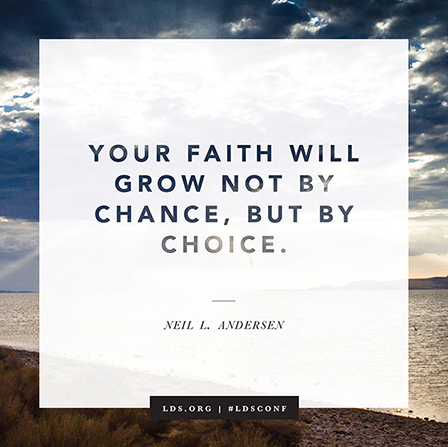
Elder Andersen, of the Quorum of the Twelve Apostles, gave an excellent talk in October 2015 entitled Faith Is Not by Chance, but by Choice.
How Does the Savior See my Faith?
I hope we will all reflect upon and ponder the question Elder Andersen asked us to consider: "How does the Savior see my faith?" Pondering this question will help us see what we lack and inspire us to know what actions we can take in our lives to strengthen our faith.
Faith Misunderstood
It's true that faith is a gift from God; however, many misinterpret this to mean that you're either blessed with faith or you're not. It is a myth that some are born with faith or inherit faith. Those who seek faith will obtain it from the Lord. It is also commonly misunderstood that one faith promoting experience, such as a miraculous healing through a Priesthood blessing, or even a period of time where many faith promoting experiences occur, such as a two-year mission, are sufficient to sustain our faith throughout our lives. Faith has a short shelf life. As Elder Andersen says, "Your faith is either growing stronger or becoming weaker." Recall how Laman and Lemuel experienced many faith-promoting miracles (angels spoke to them!), yet their faith and repentance did not last long or sustain them through their trials.
Faith Is a Choice
Faith is a choice. Elder Andersen says, "The future of your faith is not by chance, but by choice." He continues, "How we live our lives increases or diminishes our faith. Prayer, obedience, honesty, purity of thought and deed, and unselfishness increase faith. Without these, faith diminishes."
Why Choose Faith
This may seem obvious to many, but I will share a few reasons why we should choose faith:
How Do I Choose Faith?
As Elder Andersen mentioned, there are many things we can do daily to choose faith. Many overlook these because of their simplicity. Naaman refused to bathe in the Jordan because it seemed to simple to cure him of his leprosy (later chose faith, obeyed, and was healed). How many Jews died from the poisonous serpents in the wilderness because they would not hearken unto Moses and look upon the brazen serpent to be healed? It was just too simple. Will we set aside personal prayer because of its simplicity? Will we forgo scripture study because it seems so simple, plus we've read them before? Will we cease to attend church meetings? Will we fail in our callings and duties or refuse to accept them? Choosing faith means choosing to keep the commandments of the Lord, to obey His chosen leaders, to live lives of integrity and virtue, and to serve those around us. As you can see, it's much more than checking a few boxes; it's choosing a faith-filled lifestyle.
Faith and Questions
Elder Andersen teaches, "Addressing honest questions is an important part of building faith, and we use both our intellect and our feelings." We are encouraged to be inquisitive, ever-learning, and always seeking further truth and light and knowledge. I hope nobody ever feels that they should not ask questions or that honest questions indicate a lack of faith. Joseph Smith would not have had his miraculous experience without humbly posing his honest question to God. Much of the revelation that we can and have (collectively) received has been the direct result of honest questions. In my personal life, I've asked questions of the Lord and of my leaders and benefited greatly by the answers I've received through the Spirit. Even as faith increases through honest questions and the revelation that results, we must not lose faith when answers come slowly or not at all.
Elder Andersen states, "Faith never demands an answer to every question but seeks the assurance and courage to move forward, sometimes acknowledging, 'I don't know everything, but I do know enough to continue on the path of discipleship.'"As we seek answers in faith, we will have the confidence to move forward.
Satan Seeks to Destroy Faith
It goes without saying that the adversary would like to destroy our faith. All around us the world, under his influence, seeks to undermine the faith that we have gained and to prevent us from choosing to strengthen our faith through righteous living. The Internet, and especially Social Media, is full of unbelievers who would sabotage our faith with the philosophies of men, societal trends, difficult questions that tug at our heart strings, and historical facts and fiction that are difficult to distinguish. Never before in the history of the world has anti-Mormon doctrine, largely perpetuated by apostates, been so accessible. Not only is it accessible, but those of us on Social Media often find ourselves inundated with it. This presents us with an crossroad of choice between faith and doubt. Elder Andersen teaches, "Immersing oneself in persistent doubt, fueled by answers from the faithless and the unfaithful, weakens one's faith in Jesus Christ and the Restoration."
The Apostle Paul taught, "...but the natural man receiveth not the things of the Spirit of God: for they are foolishness unto him: neither can he know them, because they are spiritually discerned." (1 Cor 2:14). Truth and spiritual light are not received through the endless debates in Social Media incited by the faithless and the unfaithful. Be careful about the subtle influence that "friends" and "thought leaders" in Social Media can have on us and our faith.
New Mediums, Same Old Tactics
The medium may be new but the tactics are as old as time. Satan counterfeits truth by mixing with it spiritually deadly falsehoods. Common today in Social Media are the traps of political correctness and tolerance. Charity, or pure love, is distorted and polluted with ideas such tolerating sin out of love for the sinner or accepting sin in the name of love. Sin is still sin regardless of how it is framed, or whether it is tolerated/encouraged by society, and it is still necessary to separate the sinner from the sin. We can (and must) love those who choose to sin while never condoning or accepting their actions. Doubt and confusion in this regard leave us susceptible to the warning given by Alexander Pope:
What to Do When Faith Is Challenged?
All of us have moments when our faith may be challenged and when it can be difficult to push aside doubts. Luckily, there are proactive steps we can take to choose faith in these moments.
Prayer
Humbly asking our Heavenly Father in prayer should be our first step. God is a reliable go-to source for comfort, guidance, and spiritual peace, which we receive through the Holy Ghost. The scriptures are full of stories of deliverance, and your loving Father will deliver you from doubt and confusion if you ask. The Lord promised that we can conquer Satan and the servants of Satan if we will "pray always" (D&C 10:5), and the Lord keeps his promises.
Remembering
Another powerful tool is remembering times in our lives when we have felt the witness of the Spirit. Journaling spiritual experiences can provide us with easy access to the memories and feelings we've had. Remember how you gained your testimony and the experiences that have strengthened it. Alma pleaded with the people of Zarahemla to remember: "if ye have experienced a change of heart, and if ye have felt to sing the song of redeeming love, I would ask, can ye feel so now?" (Alma 5:26). When Oliver Cowdery struggled with his faith, the revelation given to him was to remember the peace that the Lord had previously spoken to his mind (D&C 6:22-24).
God's Word
Open the scriptures. In Lehi's vision of the tree of life, it was the people who clung to the iron rod, which symbolises the word of God, that were able to escape the blinding temptations of the world. Elder Andersen shares this invitation, "When was the last time that you read the Book of Mormon from cover to cover? Read it again. It will increase your faith." I would add to that the invitation to again put Moroni's promise (Moroni 10:3-4) to the test by asking God to confirm to your heart and mind the truthfulness of the Book of Mormon as you study it. What greater witness can you receive than from God? And what better way to strengthen your faith and dispel doubt than through receipt of this divine confirmation? It's not a one-time thing - you can receive this spiritual confirmation as many times as you read, ponder, and sincerely ask to know of its truthfulness.
Service
Service is a miracle because it has the power to heal us of so many ailments, including doubt. Through providing meaningful service to others, we step outside of ourselves and focus more on the needs of others than our own. Service fills us with God's love, charity, which promotes faith. Service can change our heart as we are filled with this love.
Conclusion
Elder Andersen teaches that "your faith did not begin at birth, and it will not end at death. Faith is a choice." And in the words of President Monson, "Fear not... the future is as bright as your faith." I pray that we will all choose faith and enjoy the peace and happiness that results therefrom.

How Does the Savior See my Faith?
I hope we will all reflect upon and ponder the question Elder Andersen asked us to consider: "How does the Savior see my faith?" Pondering this question will help us see what we lack and inspire us to know what actions we can take in our lives to strengthen our faith.
Faith Misunderstood
It's true that faith is a gift from God; however, many misinterpret this to mean that you're either blessed with faith or you're not. It is a myth that some are born with faith or inherit faith. Those who seek faith will obtain it from the Lord. It is also commonly misunderstood that one faith promoting experience, such as a miraculous healing through a Priesthood blessing, or even a period of time where many faith promoting experiences occur, such as a two-year mission, are sufficient to sustain our faith throughout our lives. Faith has a short shelf life. As Elder Andersen says, "Your faith is either growing stronger or becoming weaker." Recall how Laman and Lemuel experienced many faith-promoting miracles (angels spoke to them!), yet their faith and repentance did not last long or sustain them through their trials.
Faith Is a Choice
Faith is a choice. Elder Andersen says, "The future of your faith is not by chance, but by choice." He continues, "How we live our lives increases or diminishes our faith. Prayer, obedience, honesty, purity of thought and deed, and unselfishness increase faith. Without these, faith diminishes."
Why Choose Faith
This may seem obvious to many, but I will share a few reasons why we should choose faith:
- Faith in Jesus Christ is required to partake of his Atonement and be saved.
- At baptism, we have covenanted (a sacred promise) with God that we would have faith. Additional covenants are made in the temple.
- Faith gives us the power to overcome our trials and continue improving ourselves.
- Both hope and charity require faith.
- Living by faith provides a confidence, peace, and joy not found through any other means.
- Faith can eliminate doubt, fear, and worry from our lives.
How Do I Choose Faith?
As Elder Andersen mentioned, there are many things we can do daily to choose faith. Many overlook these because of their simplicity. Naaman refused to bathe in the Jordan because it seemed to simple to cure him of his leprosy (later chose faith, obeyed, and was healed). How many Jews died from the poisonous serpents in the wilderness because they would not hearken unto Moses and look upon the brazen serpent to be healed? It was just too simple. Will we set aside personal prayer because of its simplicity? Will we forgo scripture study because it seems so simple, plus we've read them before? Will we cease to attend church meetings? Will we fail in our callings and duties or refuse to accept them? Choosing faith means choosing to keep the commandments of the Lord, to obey His chosen leaders, to live lives of integrity and virtue, and to serve those around us. As you can see, it's much more than checking a few boxes; it's choosing a faith-filled lifestyle.
Faith and Questions
Elder Andersen teaches, "Addressing honest questions is an important part of building faith, and we use both our intellect and our feelings." We are encouraged to be inquisitive, ever-learning, and always seeking further truth and light and knowledge. I hope nobody ever feels that they should not ask questions or that honest questions indicate a lack of faith. Joseph Smith would not have had his miraculous experience without humbly posing his honest question to God. Much of the revelation that we can and have (collectively) received has been the direct result of honest questions. In my personal life, I've asked questions of the Lord and of my leaders and benefited greatly by the answers I've received through the Spirit. Even as faith increases through honest questions and the revelation that results, we must not lose faith when answers come slowly or not at all.
Elder Andersen states, "Faith never demands an answer to every question but seeks the assurance and courage to move forward, sometimes acknowledging, 'I don't know everything, but I do know enough to continue on the path of discipleship.'"As we seek answers in faith, we will have the confidence to move forward.
Satan Seeks to Destroy Faith
It goes without saying that the adversary would like to destroy our faith. All around us the world, under his influence, seeks to undermine the faith that we have gained and to prevent us from choosing to strengthen our faith through righteous living. The Internet, and especially Social Media, is full of unbelievers who would sabotage our faith with the philosophies of men, societal trends, difficult questions that tug at our heart strings, and historical facts and fiction that are difficult to distinguish. Never before in the history of the world has anti-Mormon doctrine, largely perpetuated by apostates, been so accessible. Not only is it accessible, but those of us on Social Media often find ourselves inundated with it. This presents us with an crossroad of choice between faith and doubt. Elder Andersen teaches, "Immersing oneself in persistent doubt, fueled by answers from the faithless and the unfaithful, weakens one's faith in Jesus Christ and the Restoration."
The Apostle Paul taught, "...but the natural man receiveth not the things of the Spirit of God: for they are foolishness unto him: neither can he know them, because they are spiritually discerned." (1 Cor 2:14). Truth and spiritual light are not received through the endless debates in Social Media incited by the faithless and the unfaithful. Be careful about the subtle influence that "friends" and "thought leaders" in Social Media can have on us and our faith.
New Mediums, Same Old Tactics
The medium may be new but the tactics are as old as time. Satan counterfeits truth by mixing with it spiritually deadly falsehoods. Common today in Social Media are the traps of political correctness and tolerance. Charity, or pure love, is distorted and polluted with ideas such tolerating sin out of love for the sinner or accepting sin in the name of love. Sin is still sin regardless of how it is framed, or whether it is tolerated/encouraged by society, and it is still necessary to separate the sinner from the sin. We can (and must) love those who choose to sin while never condoning or accepting their actions. Doubt and confusion in this regard leave us susceptible to the warning given by Alexander Pope:
“Vice is a monster of so frightful mienOur faith diminishes as we allow ourselves to be surrounded by the doubts perpetuated by the faithless and unfaithful.
As to be hated needs but to be seen;
Yet seen too oft, familiar with her face,
We first endure, then pity, then embrace.”
What to Do When Faith Is Challenged?
All of us have moments when our faith may be challenged and when it can be difficult to push aside doubts. Luckily, there are proactive steps we can take to choose faith in these moments.
Prayer
Humbly asking our Heavenly Father in prayer should be our first step. God is a reliable go-to source for comfort, guidance, and spiritual peace, which we receive through the Holy Ghost. The scriptures are full of stories of deliverance, and your loving Father will deliver you from doubt and confusion if you ask. The Lord promised that we can conquer Satan and the servants of Satan if we will "pray always" (D&C 10:5), and the Lord keeps his promises.
Remembering
Another powerful tool is remembering times in our lives when we have felt the witness of the Spirit. Journaling spiritual experiences can provide us with easy access to the memories and feelings we've had. Remember how you gained your testimony and the experiences that have strengthened it. Alma pleaded with the people of Zarahemla to remember: "if ye have experienced a change of heart, and if ye have felt to sing the song of redeeming love, I would ask, can ye feel so now?" (Alma 5:26). When Oliver Cowdery struggled with his faith, the revelation given to him was to remember the peace that the Lord had previously spoken to his mind (D&C 6:22-24).
God's Word
Open the scriptures. In Lehi's vision of the tree of life, it was the people who clung to the iron rod, which symbolises the word of God, that were able to escape the blinding temptations of the world. Elder Andersen shares this invitation, "When was the last time that you read the Book of Mormon from cover to cover? Read it again. It will increase your faith." I would add to that the invitation to again put Moroni's promise (Moroni 10:3-4) to the test by asking God to confirm to your heart and mind the truthfulness of the Book of Mormon as you study it. What greater witness can you receive than from God? And what better way to strengthen your faith and dispel doubt than through receipt of this divine confirmation? It's not a one-time thing - you can receive this spiritual confirmation as many times as you read, ponder, and sincerely ask to know of its truthfulness.
Service
Service is a miracle because it has the power to heal us of so many ailments, including doubt. Through providing meaningful service to others, we step outside of ourselves and focus more on the needs of others than our own. Service fills us with God's love, charity, which promotes faith. Service can change our heart as we are filled with this love.
Conclusion
Elder Andersen teaches that "your faith did not begin at birth, and it will not end at death. Faith is a choice." And in the words of President Monson, "Fear not... the future is as bright as your faith." I pray that we will all choose faith and enjoy the peace and happiness that results therefrom.
Sunday, September 2, 2012
What Lehi Taught about Agency
What is agency?
Agency is the freedom to choose that God has given to each of us (2 Nephi 2:16). Agency is the reason why there is opposition in all aspects of life. Does it make sense to give someone the ability to choose without them having options?
This is important. God gave us agency so that we are not forced to do anything. He did not force Adam and Eve to eat of the forbidden fruit and die, but He did give them the opportunity to do so if they chose. Mortality was the consequence of this choice because it was a choice to follow this plan - the plan of salvation - in the first place. In the pre-existence, God did not force us to come to earth, and once on earth, he will not force us to return to him. It's all about choices.
How does it affect me?
Remember that "Adam fell that men might be; and men are, that they might have joy" (2 Nephi 2:25). Adam's choice made it possible for us to be here, as was previously discussed. We are here to make choices and we are here to have joy. Logically, that means we are here to make the choices that will bring us joy, right? That's where we come in.
Lehi taught:
The liberty and eternal life is through the great Mediator of all men - Jesus Christ atoned for us and "bought us with a price" so that he can plead for us before the Father as our mediator. He paid the consequences of our sin so that we will not have to - if we choose Him. Choosing Christ will lead us to liberty as we will not be captive to sin and is the path to eternal life.
Captivity and death are according to the captivity and power of the devil. These are exact opposites of what Christ offers us. Instead of the liberty of righteous living, we are free to choose the spiritual bondage of sin, which limits our choices. If we choose this path of sin, we will have to pay for the consequences of the sin - spiritual death. No unclean thing can dwell with God, so choosing sin and death puts us outside of his presence eternally. Interesting that he uses the word "power" because Satan has REAL power over us when we sin. Sin is how we give him this power. Living righteously prevents him from having any power over us.
He seeketh that we might be miserable like he is - Satan is miserable. How could he not be? He had the potential to be like God (as any son has the potential to be like his father), but he chose to pridefully reject God's plan and rebel. His consequence was to eternally be out of God's presence and to forfeit the eternal inheritance that could have been his. This would make anyone miserable. He can't get back at God but in one way, bringing us down with him. God loves each and every one of us with a love we cannot fathom. How much it must pain God to lose one of his precious sons or daughters!! Satan's only retribution is to bring us down into the misery, captivity and death in which he is fully engulfed.
He will try everything to trip us up. And he succeeds much too often in each of our lives because we are human, frail in our mortal state; however, there is always a way to escape. It is not too late to choose to follow Jesus Christ and to choose liberty and eternal life. The choice is yours. You know the consequences both temporal and eternal. Choose the right!
Agency is the freedom to choose that God has given to each of us (2 Nephi 2:16). Agency is the reason why there is opposition in all aspects of life. Does it make sense to give someone the ability to choose without them having options?
This is important. God gave us agency so that we are not forced to do anything. He did not force Adam and Eve to eat of the forbidden fruit and die, but He did give them the opportunity to do so if they chose. Mortality was the consequence of this choice because it was a choice to follow this plan - the plan of salvation - in the first place. In the pre-existence, God did not force us to come to earth, and once on earth, he will not force us to return to him. It's all about choices.
How does it affect me?
Remember that "Adam fell that men might be; and men are, that they might have joy" (2 Nephi 2:25). Adam's choice made it possible for us to be here, as was previously discussed. We are here to make choices and we are here to have joy. Logically, that means we are here to make the choices that will bring us joy, right? That's where we come in.
Lehi taught:
Wherefore, men are free according to the flesh; and all things are given them which are expedient unto man. And they are free to choose liberty and eternal life, through the great Mediator of all men, or to choose captivity and death, according to the captivity and power of the devil; for he seeketh that all men might be miserable like unto himself. (2 Nephi 2:27)Let's break this down. Men are free - we know that and discussed that already. All things are given us which are expedient - to me this is the light of Christ (or our conscience) that we all have. We know right from wrong, all of us, so we are able to make choices with accountability. We are free to choose liberty and eternal life or captivity and death - these are really our only two choices. Everything we do brings us towards one or the other, though we don't usually look at our choices this way.
The liberty and eternal life is through the great Mediator of all men - Jesus Christ atoned for us and "bought us with a price" so that he can plead for us before the Father as our mediator. He paid the consequences of our sin so that we will not have to - if we choose Him. Choosing Christ will lead us to liberty as we will not be captive to sin and is the path to eternal life.
Captivity and death are according to the captivity and power of the devil. These are exact opposites of what Christ offers us. Instead of the liberty of righteous living, we are free to choose the spiritual bondage of sin, which limits our choices. If we choose this path of sin, we will have to pay for the consequences of the sin - spiritual death. No unclean thing can dwell with God, so choosing sin and death puts us outside of his presence eternally. Interesting that he uses the word "power" because Satan has REAL power over us when we sin. Sin is how we give him this power. Living righteously prevents him from having any power over us.
He seeketh that we might be miserable like he is - Satan is miserable. How could he not be? He had the potential to be like God (as any son has the potential to be like his father), but he chose to pridefully reject God's plan and rebel. His consequence was to eternally be out of God's presence and to forfeit the eternal inheritance that could have been his. This would make anyone miserable. He can't get back at God but in one way, bringing us down with him. God loves each and every one of us with a love we cannot fathom. How much it must pain God to lose one of his precious sons or daughters!! Satan's only retribution is to bring us down into the misery, captivity and death in which he is fully engulfed.
He will try everything to trip us up. And he succeeds much too often in each of our lives because we are human, frail in our mortal state; however, there is always a way to escape. It is not too late to choose to follow Jesus Christ and to choose liberty and eternal life. The choice is yours. You know the consequences both temporal and eternal. Choose the right!
Friday, April 1, 2011
Why Does God Allow Bad Things to Happen?
I know this is a common question asked after the death of a loved one, a natural disaster occurs, or some other tragedy takes place. We must remember that God never causes bad things to happen, so the question is "why does God allow bad things to happen?" At the root, it comes down to God giving us agency and not forcing anybody to do anything- we have to make choices because that's one of the reasons we're here on earth. Let's see what else we can learn from the Book of Mormon to help understand the answer to this question.
Lehi explains to his son Jacob that the devil, evil, wickedness, and all bad things exist for a reason- to provide us with "an opposition in all things" (2 Nephi 2:11). The reason this opposition is so important is that "the Lord God gave unto man that he should act for himself. Wherefore, man could not act for himself save it should be that he was enticed by the one or the other" (2 Nephi 2:16). So in order for me to truly have agency, I must have choices. If choices or options do not exist, then how can I have agency or the freedom of choice? So, the devil provides us with opportunities to choose poorly while God seeks to guide us to choose righteously through the influence of the Holy Ghost and also the light of Christ, also known as our conscience. Everyone is born with a conscience, knowing right from wrong, so that we can choose for ourselves and be held accountable for those choices.
I think it's also important to remember that even bad things can and do turn out alright in the end. It's true that our trials make us stronger and we can learn so many valuable lessons from our mistakes. Lehi told Jacob, "Nevertheless, Jacob, my first-born in the wilderness, thou knowest the greatness of God; and he shall consecrate thine afflictions for thy gain" (2 Nephi 2:2). I believe that this is true for all of us if we endure our afflictions well.
A Biblical example of this is the Fall of Adam and Eve. They transgressed God's command to not eat of the forbidden fruit, yet much good has come of that transgression. If not for them eating of the fruit and being kicked out of the Garden of Eden, we would not have ever been born (2 Nephi 2:22-25).
Lehi describes - basically as his final words to his sons - agency and our freedom of choice:
Two prophets who were preaching as missionaries ran into this same question. Many of those converted to the true gospel of Christ were being burned at the stake by non-believers. Amulek turned to Alma and essentially asked, "Why is this awful thing happening? Can't we call upon God to put an end to it?" God's answer, which came through his prophet Alma can also help answer the question we're discussing: "The Spirit constraineth me that I must not stretch forth mine hand; for behold the Lord receiveth them up unto himself, in glory; and he doth suffer that they may do this thing, or that the people may do this thing unto them, according to the hardness of their hearts, that the judgments which he shall exercise upon them in his wrath may be just; and the blood of the innocent shall stand as a witness against them, yea, and cry mightily against them at the last day" (Alma 14:9-11).
Similarly, God revealed to the prophet Moroni, "For the Lord suffereth the righteous to be slain that his justice and judgment may come upon the wicked; therefore ye need not suppose that the righteous are lost because they are slain; but behold, they do enter into the rest of the Lord their God" (Alma 60:13).
The experience of Alma and Amulek is especially hard to comprehend. Those people being burned to death were good, righteous people who had recently given their hearts over to God and would not deny him. Yet God allowed wicked men to kill them. We must remember that God is at the helm, meaning he sees the complete "big-picture" with a perfect perspective. All things are present to God because he can see the past, present, and future. He acts in our best interest.
If we live our lives righteously, we will never have to fear because any and all bad things that may befall us will end up being for our good.
Lehi explains to his son Jacob that the devil, evil, wickedness, and all bad things exist for a reason- to provide us with "an opposition in all things" (2 Nephi 2:11). The reason this opposition is so important is that "the Lord God gave unto man that he should act for himself. Wherefore, man could not act for himself save it should be that he was enticed by the one or the other" (2 Nephi 2:16). So in order for me to truly have agency, I must have choices. If choices or options do not exist, then how can I have agency or the freedom of choice? So, the devil provides us with opportunities to choose poorly while God seeks to guide us to choose righteously through the influence of the Holy Ghost and also the light of Christ, also known as our conscience. Everyone is born with a conscience, knowing right from wrong, so that we can choose for ourselves and be held accountable for those choices.
I think it's also important to remember that even bad things can and do turn out alright in the end. It's true that our trials make us stronger and we can learn so many valuable lessons from our mistakes. Lehi told Jacob, "Nevertheless, Jacob, my first-born in the wilderness, thou knowest the greatness of God; and he shall consecrate thine afflictions for thy gain" (2 Nephi 2:2). I believe that this is true for all of us if we endure our afflictions well.
A Biblical example of this is the Fall of Adam and Eve. They transgressed God's command to not eat of the forbidden fruit, yet much good has come of that transgression. If not for them eating of the fruit and being kicked out of the Garden of Eden, we would not have ever been born (2 Nephi 2:22-25).
Lehi describes - basically as his final words to his sons - agency and our freedom of choice:
27 Wherefore, men are free according to the flesh; and call things are given them which are expedient unto man. And they are free to choose liberty and eternal life, through the great Mediator of all men, or to choose captivity and death, according to the captivity and power of the devil; for he seeketh that all men might be miserable like unto himself.
28 And now, my sons, I would that ye should look to the great Mediator, and hearken unto his great commandments; and be faithful unto his words, and choose eternal life, according to the will of his Holy Spirit;
29 And not choose eternal death, according to the will of the flesh and the evil which is therein, which giveth the spirit of the devil power to captivate, to bring you down to hell, that he may reign over you in his own kingdom.
30 I have spoken these few words unto you all, my sons, in the last days of my probation; and I have chosen the good part, according to the words of the prophet. And I have none other object save it be the everlasting welfare of your souls. Amen. (2 Nephi 2:27-30)Simply put, choose good! Choose God!
Two prophets who were preaching as missionaries ran into this same question. Many of those converted to the true gospel of Christ were being burned at the stake by non-believers. Amulek turned to Alma and essentially asked, "Why is this awful thing happening? Can't we call upon God to put an end to it?" God's answer, which came through his prophet Alma can also help answer the question we're discussing: "The Spirit constraineth me that I must not stretch forth mine hand; for behold the Lord receiveth them up unto himself, in glory; and he doth suffer that they may do this thing, or that the people may do this thing unto them, according to the hardness of their hearts, that the judgments which he shall exercise upon them in his wrath may be just; and the blood of the innocent shall stand as a witness against them, yea, and cry mightily against them at the last day" (Alma 14:9-11).
Similarly, God revealed to the prophet Moroni, "For the Lord suffereth the righteous to be slain that his justice and judgment may come upon the wicked; therefore ye need not suppose that the righteous are lost because they are slain; but behold, they do enter into the rest of the Lord their God" (Alma 60:13).
The experience of Alma and Amulek is especially hard to comprehend. Those people being burned to death were good, righteous people who had recently given their hearts over to God and would not deny him. Yet God allowed wicked men to kill them. We must remember that God is at the helm, meaning he sees the complete "big-picture" with a perfect perspective. All things are present to God because he can see the past, present, and future. He acts in our best interest.
If we live our lives righteously, we will never have to fear because any and all bad things that may befall us will end up being for our good.
Sunday, March 15, 2009
Agency- The Freedom to Choose
One thing I love about God's plan for us is that he gives us agency. Agency can be simply defined as the freedom to choose for ourselves. God will never force us to make a decision or do something. We choose our actions (but not the consequences).
God could have created a different plan where we would be forced to choose good all the time. There could have been no suffering, sin, or evil. But how would we learn? How would we grow? Without sickness, could we really understand and appreciate health? There must be opposition so that our mortal experience is full of learning and growth.
Ultimately we are choosing daily to follow God or to follow Satan by the actions we make. When we help someone in need, we are obviously following God. When we say unkind words, we are following Satan. The sum of our smaller actions determines the path that we are on.
Lehi, in the Book of Mormon, taught:
This teaching clearly explains the consequences of choosing to follow God's plan (through Jesus Christ, the great Mediator) versus that of devil. The choice really is up to us. Living righteously is not the "popular" thing in today's world, which makes it tough. But it is the only way to obtain liberty and eternal life. All other paths, no matter how glamorous they appear, lead to captivity and death (spiritual death).
CTR: Choose the Right!
God could have created a different plan where we would be forced to choose good all the time. There could have been no suffering, sin, or evil. But how would we learn? How would we grow? Without sickness, could we really understand and appreciate health? There must be opposition so that our mortal experience is full of learning and growth.
Ultimately we are choosing daily to follow God or to follow Satan by the actions we make. When we help someone in need, we are obviously following God. When we say unkind words, we are following Satan. The sum of our smaller actions determines the path that we are on.
Lehi, in the Book of Mormon, taught:
"Wherefore, men are free according to the flesh; and call things are given them which are expedient unto man. And they are free to choose liberty and eternal life, through the great Mediator of all men, or to choose captivity and death, according to the captivity and power of the devil; for he seeketh that all men might be miserable like unto himself."
2 Nephi 2:27
This teaching clearly explains the consequences of choosing to follow God's plan (through Jesus Christ, the great Mediator) versus that of devil. The choice really is up to us. Living righteously is not the "popular" thing in today's world, which makes it tough. But it is the only way to obtain liberty and eternal life. All other paths, no matter how glamorous they appear, lead to captivity and death (spiritual death).
CTR: Choose the Right!
Sunday, December 7, 2008
Why Do People Sin When They Know It's Wrong?
After a short period of righteousness among the Nephites, they began to become wicked again. This verse describes their actions:
Why do people sin when they know it is wrong to do so? I would love to hear any thoughts that readers of this blog might have- feel free to leave a comment!
I know there are dozens of reasons. Pride, for example, could cause someone to do something wrong knowingly because he or she has a reputation to keep. Someone may justify sins as he or she seeks for power, riches, or prestige.
Satan is a tricky devil, a very good devil at that. He has been doing what he does for a long time, and he has learned how to put attractive wrapping paper and flashy ribbons on the most dangerous packages. One may think that a single pornographic image is harmless, one drink of alcohol won't hurt, or a few slots at the casino is "just for fun". However, any of these actions would allow Satan to tie a small, weak string around your wrists. It is easy enough to break free at any time, so it doesn't worry you. When you take another look at that picture, go out for another drink, or move to the poker table, another small, weak string is added. You know you can break free of those weak strings so you disregard them. As this pattern continues, you find yourself trapped, imprisoned to the father of all lies, the devil. Though it's easy to break free of a couple weak strings, it is near impossible when it becomes a rope.
I guess to summarize that story in a way that answers the question, we too often underestimate "little sins" because we underestimate the devil who is working full time to bring us into captivity to himself.
This reminds me of what the prophet Nephi taught:
Too often we have a sense of false security and allow ourselves to be led "carefully down to hell." We don't realize it until it's almost too late.
It is never completely too late, unless we die in our sins, because Jesus Christ atoned that we might be forgiven of our sins if we will repent and follow His gospel.
We can never say "the devil made me do it" but most of the time we can say "the devil convinced me to do it, but I made the choice." Satan won't pay the price of justice for the sins we commit, we will.
Let us open our eyes and realize what little things we may be doing in our lives that put small, weak strings around our wrists. Let's discover the tricks that Satan uses to deceive us and "convince" us to sin.
"Now they did not sin ignorantly, for they knew the will of God concerning them, for it had been taught unto them; therefore they did wilfully rebel against God."
3 Nephi 6:18
Why do people sin when they know it is wrong to do so? I would love to hear any thoughts that readers of this blog might have- feel free to leave a comment!
I know there are dozens of reasons. Pride, for example, could cause someone to do something wrong knowingly because he or she has a reputation to keep. Someone may justify sins as he or she seeks for power, riches, or prestige.
Satan is a tricky devil, a very good devil at that. He has been doing what he does for a long time, and he has learned how to put attractive wrapping paper and flashy ribbons on the most dangerous packages. One may think that a single pornographic image is harmless, one drink of alcohol won't hurt, or a few slots at the casino is "just for fun". However, any of these actions would allow Satan to tie a small, weak string around your wrists. It is easy enough to break free at any time, so it doesn't worry you. When you take another look at that picture, go out for another drink, or move to the poker table, another small, weak string is added. You know you can break free of those weak strings so you disregard them. As this pattern continues, you find yourself trapped, imprisoned to the father of all lies, the devil. Though it's easy to break free of a couple weak strings, it is near impossible when it becomes a rope.
I guess to summarize that story in a way that answers the question, we too often underestimate "little sins" because we underestimate the devil who is working full time to bring us into captivity to himself.
This reminds me of what the prophet Nephi taught:
"And others will he pacify, and lull them away into carnal security, that they will say: All is well in Zion; yea, Zion prospereth, all is well—and thus the devil cheateth their souls, and leadeth them away carefully down to hell."
2 Nephi 28:21
Too often we have a sense of false security and allow ourselves to be led "carefully down to hell." We don't realize it until it's almost too late.
It is never completely too late, unless we die in our sins, because Jesus Christ atoned that we might be forgiven of our sins if we will repent and follow His gospel.
We can never say "the devil made me do it" but most of the time we can say "the devil convinced me to do it, but I made the choice." Satan won't pay the price of justice for the sins we commit, we will.
Let us open our eyes and realize what little things we may be doing in our lives that put small, weak strings around our wrists. Let's discover the tricks that Satan uses to deceive us and "convince" us to sin.
Subscribe to:
Posts (Atom)
