Showing posts with label Jesus Christ. Show all posts

Wednesday, September 16, 2020

Plant Christ in Your Heart

 I've read Alma 32 and 33 many times before, but this time was different.

Alma elegantly teaches about faith with the familiar metaphor of planting and nourishing a seed. The first step isn't belief but a desire to believe. As chapter 33 begins, the people respond with, "that's a cool analogy, and the fruit sounds awesome, but what word are you talking about that we should be planting?" (paraphrasing a bit)

Alma then teaches them all about "the word" (another name for Christ) with a beautiful sermon about about Jesus Christ, pulling from the words of Zenos & Zenock and referencing Moses' example of the serpent on the staff. Then what hit me today was that after these powerful teachings about the Savior, Alma mic drops and says, "this is the word you should plant."

If you're ever struggling with your faith and wondering how to "get started" with just a "desire to believe", the word you need to plant in your heart is Jesus Christ. Focus on Him, learn of Him, and "look and live."

Sunday, June 7, 2020

Alma Beautifully Describes the Son of God, our Redeemer

26 And not many days hence the Son of God shall come in his glory; and his glory shall be the glory of the Only Begotten of the Father, full of grace, equity, and truth, full of patience, mercy, and long-suffering, quick to hear the cries of his people and to answer their prayers.  27 And behold, he cometh to redeem those who will be baptized unto repentance, through faith on his name.

This is the Savior that I worship and love. His grace is available to us all to help us in our mortal journey. He wants to help you; you're never alone.

His equity gives hope and confidence that all wrongs will be righted, that judgment will be individual and based on individual circumstances, according to the light and knowledge received.

And he is full of truth because he sees things as they really are. Truth is dependable and does not shift with popular trends and political pressures. It's reliable as He is.

Jesus is patient and long-suffering with you in your weakness. He allows you to keep trying though all of us fail often and repeatedly. He understands the process of personal growth, and because he sees the end from the beginning, he knows who you are becoming and is never disappointed in you.

His mercy is possible because of his atoning sacrifice and extends to you a hand of forgiveness. We will do nothing in this life for which we cannot attain forgiveness through faith and repentance on His name. Not only is He able to forgive you but he is merciful enough to want to forgive and help you.

He hears you and will answer your prayers. It takes faith to trust that your prayers are heard and answered, and miraculously they are. He knows and cares about you as an individual and is eager to help you. Pray for help, pray for success, pray for others, pray always. He will hear and answer.

The Savior has shown us the path to follow Him. As we faithfully repent and are baptized we make it possible for the miracle of his grace to redeem us. This is his "work and glory" and the purpose for coming to earth - redeeming you and me.

Sunday, June 30, 2019

The Pillars of Eternity Are the Human Experience

Bruce R McConkie taught in a BYU Devotional in 1981 the following:
"The three pillars of eternity, the three events, preeminent and transcendent above all others, are the creation, the fall, and the atonement. These three are the foundations upon which all things rest. Without any one of them all things would lose their purpose and meaning, and the plans and designs of Deity would come to naught."

As I pondered over these key events after a recent visit to the Oquirrh Mountain Temple, I realized that we emphasize the pillars of eternity because they are a representation of our own lives and include a pattern we must follow.

Creation Is a Spiritual Birth
The creation of the Earth is its birth and is a critical event, for without it, the future events would not be possible. The journey of discipleship begins when one is baptized, a spiritual rebirth. This is the "creation" of a member of the Church of Jesus Christ of Latter-day Saints because covenants are made to follow the Savior and take His name upon oneself. I propose that the weekly partaking of the Sacrament is a weekly "creation" as we renew our covenants and are spiritually born again.

The Fall is Personal Sin
Despite our best intentions as disciples of Jesus Christ, we sin and fall short of the glory of God. None of us can maintain the state of purity in which we arise from the baptismal waters or obtain through repentant participation in the Sacrament. Sin is not something God can tolerate and the consequences are inevitable as they are just. It leaves us in a fallen state, distanced from God and unable to make amends on our own. We find ourselves falling short weekly, even daily.

The Atonement of Jesus Christ Saves Mankind from the Fall and Us from Personal Sin
Just as Christ's Atonement saves mankind from many of the consequences of the Fall, it also saves us personally from the consequences of our own personal sins. When I sin, I know that I can receive forgiveness and be cleansed through the grace of Jesus Christ. The Savior's Atonement is infinite and should help us every time we fall short, even daily.

Conclusion
These three personal pillars of eternity are the foundation upon which all things rest in our own lives. This mortal existence loses its meaning if we do not choose to follow Christ and make repentance a part of our life throughout our journey of discipleship. We must do our best to avoid sin, but when we do make mistakes, let us recognize them as opportunities to grow closer to our Savior through sincere repentance and reliance on Him.

I personally believe this parallel is a key reason we are reminded of the pillars of eternity so powerfully in our temple worship. The process of partaking of the Sacrament weekly, of making mistakes constantly, and of relentlessly repenting is the process of sanctification and becoming perfect (eventually). This is the human experience.

Friday, June 28, 2019

Lovest Thou Me More Than These?

After the death and resurrection of the Savior, some of the Apostles returned to what they were doing when the Savior first found them - fishing. Peter and the other fishermen loved fishing, which is presumably why they chose to make a career of it. Maybe they imagined their ministry had concluded, so they could "retire" and go back to their love of fishing. It's hard to know.

The resurrected Savior found them fishing and felt the need to drive a point home to them while gathered around a campfire cooking, yes you guessed it, fish. Jesus motioned to the fish and asked Peter, "Lovest thou me more than these?"

I'm sure that Jesus was disappointed to find the Apostles fishing instead of helping Him with his work and glory. They could have been out strengthening the struggling disciples, preaching the gospel of Jesus Christ, and serving their fellowmen. Had they forgotten and moved on so quickly?

"Do you love me more than the things of the world? More than your vocation, hobbies, and passions?" was the question.

With sincerity the answer came "Yes, Lord", to which the Master responded three times "Feed my lambs... feed my sheep... feed my sheep."

The Lord was very clear that the priority of his disciples should not be entertainment or employment. The top priority and focus of our lives should be ministering to his lambs and sheep and building His Kingdom.

Do you love God more than these things?

Wednesday, June 26, 2019

On the Road to Emmaus

Two Disciples walk and dine with the resurrected Lord as recorded in Luke 24:13-35. What can we learn from this account?

What were these disciples doing at the time they encountered Jesus?
The disciples were discussing and pondering the events of and leading up to the Savior's crucifixion. This is why the Lord "drew near and went with them." As we talk of and ponder about the Savior, we invite him to draw near to us as well.

How did Jesus teach them?
First, he has asked a good open-ended question that allowed the disciples to share what they knew. Then, he met them where they were and expounded the scriptures unto them. He taught the prophesies of the prophets concerning His resurrection and helped them to understand. Our own teaching should be patterned after the Savior; teach people not lessons by starting where they are.

How did the disciples respond to His teachings?
As Jesus was about to depart, "they constrained him, saying, abide with us." They sought for Him to be with them. Do we seek for the Savior to stay with us? Do we make every effort to keep Him with us?

How did they feel when with the Savior?
The scripture describes it best: "Did not our heart burn within us, while he talked with us by the way, and while he opened to us the scriptures?" This burning of their heart is a manifestation of the Holy Ghost, which testifies of truth and testifies of Christ, who is truth. The Holy Ghost can be manifested in many ways, but it is commonly described as a burning within. When we study the scriptures or have spiritual experiences, the Holy Ghost testifies to us of truth, and we feel it inside.

What were they doing when the Savior revealed Himself to them?
Their eyes were opened, and they realized it was the Savior when he "took bread, and blessed it, and brake, and gave to them." Similarly, the Savior will reveal Himself to us as we worthily partake of the sacrament each week. We'll feel his love and know that he is there.

What did they do after learning it was the Savior?
The disciples "rose up that same hour, and returned to Jerusalem" to tell the other disciples and the Apostles that they had seen the resurrected Lord. They had gained a testimony and needed to share it with others. As we are converted to the Lord, we also have a desire to share our testimony with others and to help them become converted.

Monday, June 24, 2019

Why was the Savior's Atonement Necessary?


A Fallen World 
We live in a fallen world from which we will not escape unscathed by sin. Because of the Fall of Adam and Eve, the natural man of flesh will ensure that all of us make poor choices and commit sin during our mortal sojourn. The only one to ever walk this earth free of sin is Jesus Christ.

The Demands of Justice
The law of justice is an eternal law of consequences that cannot be avoided or nullified. Every action demands a reaction. Every choice we make demands a corresponding consequence. The most harmful consequence of sin is that it distances us from God. On our own, there is no way back to God until justice is satisfied with a punishment we're incapable of paying.

Distanced from God
A fullness of joy and inner peace will only be found when we are close to God. We cannot be truly happy when sin distances us from our Heavenly Father. This applies in the eternities as well. We strive to someday return to God's presence and receive all that he has in store for us, yet we cannot to so if the chasm of sin divides us from Him. The scriptures make it clear that God cannot look upon sin with the least degree of allowance and that in a sinful state we would rather hide ourselves from Him than come into his presence.

The Need for a Mediator
We all sin and fall short of qualifying to be in God's presence. We cannot bridge the gap on our own, which is why a Savior was prepared for us from before the foundation of the world. God knew we would sin and prepared a merciful way forward, a mediator to shield us from the eternal consequences of our mistakes and become our Lord. Rather than answer to the buffeting of Satan and his enslavement in sin, Jesus Christ has stepped in as our mediator, savior, and master.

The Atonement of Jesus Christ
Because justice must be paid, Jesus Christ came to earth as a sinless offering to satisfy the demands of justice for the redemption of all those who will repent and believe on His name.

THIS IS A BIG DEAL!

Without this infinite and eternal sacrifice, we would be lost forever. No event so significant ever has or ever will transpire on this planet! Every prophet since Adam prophesied of and looked forward to the coming of the Messiah. Every prophet since that time has also testified of that sacred event.

What Is Asked of Us?
The Savior simply asks that we repent and believe on Him, that we offer up a broken heart and a contrite spirit. He has already paid the price for our redemption. Now we just need to follow Him.

A Free Gift
Because Jesus broke the bands of death, we too will be resurrected. All of us. This is a free gift for everyone. I believe it's a reward for our choosing to follow Christ before this life. Nobody will be left behind in the grave - we all will have our body and spirit reunited to be brought before the bar of God.

His mercy goes one step further. For those who die before they've reached accountability or who live a lifetime without mental capacity for accountability, Christ's atoning sacrifice saves them. They never willingly transgressed the commandments and therefore need no repentance. Jesus satisfied the demands of justice for them.

It's my testimony that these things are true. I've made many mistakes and have felt the redeeming power of Jesus Christ's atonement in my own life time and time again.

(See 2 Nephi 2:5–10, 17–269:5–26Alma 34:8–1642:9–26.)

Thursday, May 30, 2019

Giving God Your Mite


I've often read about the "widow's mite" in the New Testament and thought that it was significant because she was poor and yet still acted obedient in keeping the law of the tithe. This in and of itself is a great example and a fine lesson, but today I understood it a little different.

You know the story:
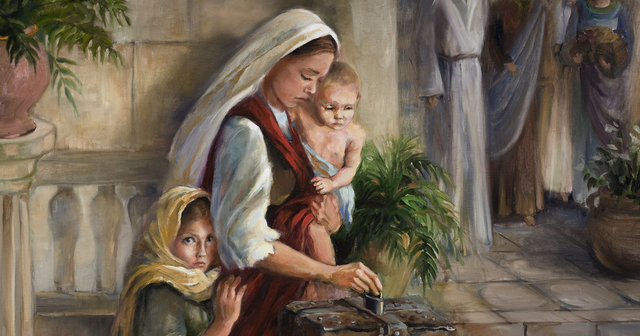
42 And there came a certain poor widow, and she threw in two mites, which make a farthing.
43 And he called unto him his disciples, and saith unto them, Verily I say unto you, That this poor widow hath cast more in, than all they which have cast into the treasury:
44 For all they did cast in of their abundance; but she of her want did cast in all that she had, even all her living.
Being all in
The key phrase that stood out to me is "[she] did cast in all that she had." The widow was all in with her faith and showed it by being all in with everything with which the Lord had blessed her. Are we all in with our faith? Do our daily choices reflect that? Can we be identified as a disciple by our fruits?

Some may think, "well, it's easier to be all in when you're poor." I propose that being all in is the same test and level of difficulty regardless of wealth, popularity, or prominence. In every circumstance it requires faith in the Lord's promised blessings.

The woman giving her all financially must trust completely on the Lord for sustenance. The rich woman giving her all financially would still have to trust completely on the Lord for sustenance, but that's not really what this is about. It's not about selling all that we have and giving to the poor, though that could be required of some; this is about the desires of our hearts.

What is the desire of your heart?
Being all in is giving your heart to the Lord. It all starts with the desires of your heart. King Benjamin told his people to "watch themselves" before telling them to watch their thoughts, words, and deeds. This is because words and deeds come from thoughts and thoughts come from desires. We must be willing to consecrate ourselves - all of our desires - to the Lord and allow Him to make much more of our lives than we ever could on our own.

Only one thing we can truly give
When the Lord owns our desires, the rest (thoughts, words, deeds) will automatically fall into place. We also learned from King Benjamin that we are and always will be unprofitable servants. Anything that we possess and give to the Lord was already his in the first place, except our will or the desires of our heart. God would never take away our agency, so it is truly the only gift that's ours to give.

In the eyes of God, the poor man who consecrates himself (his heart and soul) and everything he has to the Lord to build up His kingdom will always give more than the billionaire who donates millions to the same cause but stops short of fully consecrating his will and desires. This is how the widow's two mites infinitely dwarfs the thousands of mites donated by others. Jesus points her out as our example to follow.

Conclusion
Give your mite to the God by giving your whole self to Him. Kneel down and commit yourself, all the desires of your heart, to the Lord, and then go and do His will. This truly is the only offering you can possibly place on the alter; anything else was first given to you from Him. Be willing to give up anything and everything for God by loving Him first, and then show it with how you live each and every day.

Wednesday, May 22, 2019

Don't Be a Hypocrite

You've probably heard someone say, "If you're going to talk the talk, you better walk the walk." Or said another way, "practice what you preach." Hypocrisy is when you teach or advocate something publicly and then do not practice it in private.

Jesus is not a fan of hypocrisy (obviously). In fact, he had some pretty harsh words for the pharisees and scribes when he called them out for their hypocrisy:

"Woe unto you, scribes and Pharisees, hypocrites! ... Ye serpents, ye generation of vipers, how can ye escape the damnation of hell?" 

He did not mince words. One of my favorite of the Savior's metaphors was directed at these hypocritical teachers of the people in Matthew 23:27-28:
27 Woe unto you, scribes and Pharisees, hypocrites! for ye are like unto whited sepulchres, which indeed appear beautiful outward, but are within full of dead men’s bones, and of all uncleanness. 
28 Even so ye also outwardly appear righteous unto men, but within ye are full of hypocrisy and iniquity.

He warns his disciples that while they should do many of the things the pharisees and scribes taught (they taught from the scriptures), they should beware to not do the things that they did:

"All therefore whatsoever they bid you observe, that observe and do; but do not ye after their works: for they say, and do not."

The prophet Abinadi observed the same thing happening with King Noah's wicked priests. He asked  them "If ye teach the Law of Moses, why do ye not keep it?"

This seems to be an easy trap to fall into when you're in power and care more about using the Word to stay in power than to serve the Lord. A good leader does the exact opposite. The Lord prescribed this model for leaders:
"But he that is greatest among you shall be your servant. And whosoever shall exalt himself shall be abased; and he that shall humble himself shall be exalted." 
This is also important in parenting. Some parents take the approach of telling their kids essentially, "Do as I say and not as I do." Good luck with that. Every child wants to be like his mom or dad. They mimic their parents from a very early age. They try to wear their parents' shoes, and they repeat the phrases their parents use, often to the embarrassment of their parents (my two-year-old is now saying, "what the heck?" ... *face palm*)!

Lastly, it's not possible to experience an inner peace while living a double-life. When there's a disconnect between your words and your actions, turmoil and uneasiness will be your constant companion. Jesus's invitation to change and repent included the pharisees discussed here, and it includes us.

We can always repent and close the gap between our words and deeds. It's never too late to walk the walk because the Savior has already satisfied the demands of justice for us. Turn to him for He is the way to your inner peace in this life and salvation in the life to come.


Friday, February 5, 2016

Choose Eternal Life

Lehi teaches his family the Plan of Salvation, and gives a powerful testimony of agency and the importance of choosing to follow the Gospel of Jesus Christ. I think 2 Nephi 2:27 is powerful as it clearly illustrates the destination we will attain depending on our use of agency. Lehi says:
Wherefore, men are free according to the flesh; and all things are given them which are expedient unto man. And they are free to choose liberty and eternal life, through the great Mediator of all men, or to choose captivity and death, according to the captivity and power of the devil; for he seeketh that all men might be miserable like unto himself.
After describing this choice to his sons, he exhorts them to "look to the great Mediator, and hearken unto his great commandments; and be faithful unto his words." Then with the pleadings of a loving parent who knows he will soon pass away, Lehi says, "choose eternal life." 

It's true that this may seem overly simplistic. We don't just decide, "I'm going to choose eternal life," and then we're set. But along with this simple plea, he does provide instruction for accomplishing this important goal. He points his sons to the Savior, Jesus Christ, and he exhorts them to obey the commandments. This reminds me of the third article of faith: We believe that through the atonement of Christ, all mankind may be saved, by obedience to the laws and ordinances of the Gospel.

Turn to Christ and obey His commandments. Choose Eternal Life!

Sunday, April 14, 2013

Mosiah 3:19 - How to Overcome the Natural Man

One of my favorite scriptures is from King Benjamin's address in Mosiah 3:19 where he teaches:

"For the natural man is an enemy to God, and has been from the fall of Adam, and will be, forever and ever, unless he yields to the enticings of the Holy Spirit, and putteth off the natural man and becometh a saint through the atonement of Christ the Lord, and becometh as a child, submissive, meek, humble, patient, full of love, willing to submit to all things which the Lord seeth fit to inflict upon him, even as a child doth submit to his father."

This is a powerful lesson in how to overcome the desires of the flesh and work towards perfection. He breaks it down into three things we must do:

(1) Yield to the enticings of the Holy Spirit
After baptism, we are confirmed and given the Gift of the Holy Ghost. This gift entitles us to the constant companionship of the Spirit as long as we remain worthy, for the Spirit cannot dwell in an unholy tabernacle. The Spirit warns us of danger and is influential in showing us a way to escape temptation because the Lord always prepares a way for our escape (see 1 Cor 10:13) so that we are able to use our agency in overcoming the temptation. We must listen to the still small voice.

(2) Put off the natural man, becoming a saint through the Atonement
To me "putting off" the natural man is about commitment. We must commit to ourselves and to God that we are going to do better, think better, speak better and be better. But it is not usually possible to just "put off" the natural man with one firm commitment because we're human and we slip up from time to time. This is why the Atonement of Jesus Christ is an essential element in overcoming the flesh. As often as we sincerely repent, the Lord will forgive us. This step is really a continuous cycle of commitment, effort, falling short, repenting and being forgiven through the Atonement. The goal should be to do a little better each time - we must constantly be improving and progressing, but perfection is not expected of us the first time.

(3) Become as a child
We must develop childlike attributes such as those listed by King Benjamin: "submissive, meek, humble, patient, full of love, willing to submit to all things which the Lord seeth fit to inflict upon him, even as a child doth submit to his father." These attributes lead to us being able to see the big picture of God's will and accept his will. They also lead us to become more like our Savior, full of charity - a pure love - for everyone around us. As we are filled with charity, we cannot help but want to serve our fellowman, and in this service there is no place for selfishness and the natural man, for they have been pushed out of our lives and replaced with an attitude of service.


Friday, March 29, 2013

How Can the Atonement Help Me During My Trials?

What can we learn from the scriptures about this?
Matthew 11:28–30; Christ promises us that if we "come unto" Him, he will give us rest by sharing our burden. He also offers to let us take his yoke upon us so that we might find "rest unto [our] souls." We know that his yoke, or work, is to bring about the "immortality and eternal life of man," so if we embark with the same yoke, or work, we are also promised rest. I don't think he means physical rest, but rather an inner peace.
Philippians 4:13; This is true. Christ can give us the strength to do all things.
1 Nephi 17:3; The promise that if we're obedient to God, he will nourish and strengthen us so that we can accomplish everything we need to do.
Helaman 5:12We need to build our "foundations" upon Christ. He is the solid rock that will keep us safe and steady during hard times. It isn't "if" but "when" hard times come that we will need to have our Savior's help to make it through. And if we've built our foundation on Christ we "cannot fail."
D&C 68:6We should not fear for we have Jesus Christ with us at our side.

Mosiah 24:8–17; When Alma and his people were in bondage, they had great trials as slaves to the wicked Lamanites and in particular Amulon. They poured out their hearts to God for relief and he responded. He promised to deliver them out of bondage, and in the meantime, he "eased their burdens" so that they "could not feel them." After their burdens were made light, they submitted cheerfully to the will of the Lord and continued in their trials. Because of "their faith and their patience" the Lord caused a miracle to occur so that they could escape from bondage. This can apply to us in so many ways - from tough trials beyond our control to the bondage of sin (which is also a tough trial, though self-inflicted). Regardless of the cause of our trials, we can turn to the Lord and through his atonement be helped so that our burdens may be lighter.

Alma 7:11–13 ; the "power of his deliverance" comes from the atonement where Jesus Christ suffered "pains, afflictions and temptations of every kind" and took upon him the "pains and sicknesses of his people" so that "his bowels may be filled with mercy, according to the flesh, that he may know according to the flesh how to succor his people according to their infirmities." He suffered everything so that he could understand our trials, fears, temptations, pains, sins, sicknesses, etc so that he can help us with everything we go through. (See also Isaiah 53:3-5 and D&C 19:16-19)